
The Lendela Team
May 15th, 2026
Table of contents
- In Q1 2026, EVs made up 57.6% of all new car registrations in Singapore – the shift is already well underway.
- Buyers in 2026 can save up to $30,000 in combined EEAI and VES rebates – the EEAI ends 31 December 2026 and will not return.
- EVs with a motor output of up to 110kW qualify for the cheaper Category A COE, covering popular models like the GAC Aion ES and Tesla Model 3 RWD.
- Switching from petrol to electric saves an estimated $3,000–$3,500 per year in energy costs based on May 2026 fuel and tariff rates.
- Home charging at 29.72 cents/kWh is roughly half the cost of public fast charging – a home charger pays for itself quickly if your carpark allows it.
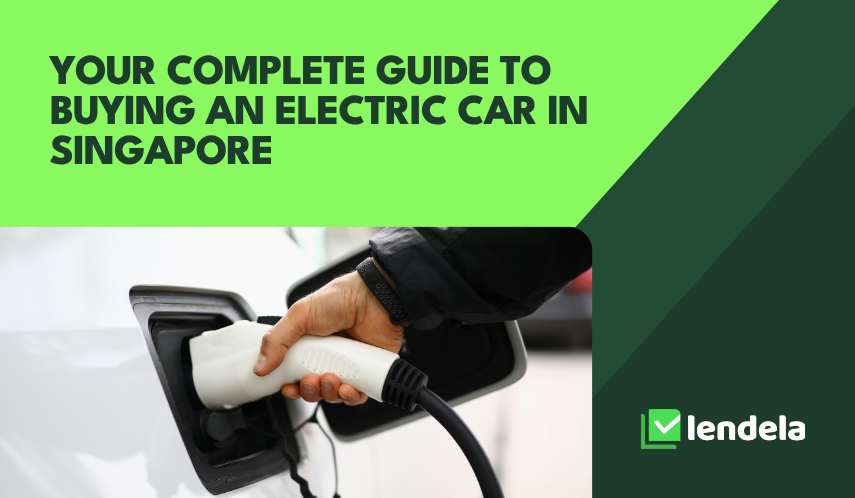
Singapore has set two firm deadlines for going green. From 2030, all new car and taxi registrations must be cleaner-energy vehicles. By 2040, all vehicles on the road must follow. Far from a distant goal, the shift is already happening – in Q1 2026, EVs made up 57.6% of all new car registrations in Singapore. If you are considering making the switch, this guide covers what you need to know before buying.
Common electric car models in Singapore
Here are some of the most popular EVs available in Singapore in 2026.
Manufacturer | Model | Type | Price (incl. COE) | Range |
|---|---|---|---|---|
GAC Aion | ES | Sedan | From $132,988 | 480 km |
BYD | Dolphin | Hatchback | From ~$159,000 | 427 km |
BYD | Atto 3 (100kW) | SUV | From $178,888 | 420 km |
Hyundai | Kona Electric | SUV | $177,888–$209,888 | 454–625 km |
Tesla | Model 3 RWD | Sedan | Cat A (110kW) | 554 km |
Prices include prevailing COE as of May 2026 and are subject to change.
Entry-level EVs in Singapore now start at around $133,000. As with petrol cars, pay attention to the range – the distance the car can travel on a full charge – and the motor's power output in kW, which determines its COE category.
Understanding COE for electric cars
COE is typically the single largest cost in an EV purchase. Since 2024, EVs with a maximum power output of up to 110kW qualify for the cheaper Category A COE – covering popular models such as the GAC Aion ES, BYD Atto 3 (100kW), and Tesla Model 3 RWD.
COE premiums – May 2026 (1st bidding):
Category | Premium |
|---|---|
Cat A (up to 110kW) | $124,790 |
Cat B (above 110kW) | $126,236 |
COE premiums change every two weeks via open bidding. Always confirm the on-the-road price with your dealer before committing.
Rebates to expect for buying an electric car in Singapore
Two main schemes are currently available.
EV Early Adoption Incentive (EEAI) A 45% rebate off your ARF, capped at $7,500. This scheme ends on 31 December 2026 and will not be renewed – buyers this year are the last to benefit.
Vehicular Emissions Scheme (VES) An upfront rebate applied at registration. From 2026, only fully electric vehicles qualify – hybrids are no longer eligible.
2026: $22,500 rebate (Band A)
2027: $20,000 rebate (Band A)
ARF floor: Remains at $0 for electric cars, extended through 31 December 2027.
Combined maximum rebate:
Year | EEAI | VES | Total |
|---|---|---|---|
2026 | $7,500 | $22,500 | $30,000 |
2027 | – | $20,000 | $20,000 |
2026 is the last year both schemes can be combined. From 2027, buyers lose the EEAI entirely.
Road tax for EVs is calculated on motor power output (kW), not engine size. All electric cars also pay an Additional Flat Component (AFC) of $700/year. Entry-level EVs typically pay $700–$900/year in total road tax.
The usual PARF and COE rebates will still apply when you deregister your electric car.
Get Your Loan Options
Find tailored offers in minutes — free to check, with no impact on your credit score.


Switching to an electric car: how much can you save?
The main benefit of switching is saving money on energy. Here are updated estimates based on current figures.
Assumptions used:
(i) Average annual distance covered: 17,500 km.
(ii) Price of petrol (95-octane): $2.95 per litre (average May 2026; peaked at $3.30/litre in March 2026).
(iii) Electricity tariff in Singapore: 29.72 cents/kWh including GST (SP Group regulated tariff, Q2 2026).
Based on these figures and the same annual distance, the indicative annual energy saving from switching to an EV is approximately $3,000–$3,500 – nearly double earlier estimates, driven largely by higher petrol prices.
Beyond fuel costs, electric cars also tend to have lower maintenance costs. Fewer moving parts means less wear and tear – no oil changes, fewer brake replacements (due to regenerative braking), and generally lower servicing costs over time.
Note: Petrol prices and electricity tariffs are reviewed quarterly. Use these figures as a guide only.
What about charging your electric car?
Singapore's charging network has grown significantly. As of March 2026, there are over 30,500 EV charging points nationwide – past the halfway mark toward the government's target of 60,000 by 2030. Over 90% of HDB carparks now have chargers installed.
Here are the main public charging operators and current rates:
Operator | Points | AC rate | DC rate |
|---|---|---|---|
Charge+ | 4,000+ | $0.61–$0.63/kWh | $0.67–$0.73/kWh |
SP Mobility | 3,300+ | $0.58–$0.74/kWh | $0.75–$0.82/kWh |
Shell Recharge | ~85 stations | $0.65–$0.74/kWh | $0.76–$0.83/kWh |
TotalEnergies | Multiple | ~$0.60/kWh | ~$0.66/kWh |
ComfortDelGro–ENGIE | 2,000+ | $0.65–$0.67/kWh | $0.72–$0.74/kWh |
Rates as of May 2026. Check the operator's app for the latest pricing.
Home charging remains the cheapest option at the regulated tariff of 29.72 cents/kWh – roughly half the cost of public fast charging. If your home or carpark allows it, installing a home charger will significantly reduce your running costs.
How does buying an electric car differ from an ICE car?
The process is largely the same – visit a dealer, choose your car, arrange financing, and drive away. The key difference is that timing matters more with EVs. Rebate schemes have deadlines, COE premiums fluctuate, and understanding your home charging situation before you buy will save headaches later.
If financing is part of the equation, a personal loan is a common route for EV purchases in Singapore. Banks and financial institutions offer personal loans that can be used for vehicle purchases – and comparing offers before committing can save a meaningful amount over the loan tenure.
Lendela is a loan matching platform that lets you apply once and receive personalised personal loan offers from multiple banks and financial institutions simultaneously. No need to approach each bank separately, and no impact on your credit score from comparing options.
Ready to make the switch?
With the EEAI ending on 31 December 2026, buyers who act this year save up to $7,500 that will not be available in 2027. If you need financing, compare your options before committing to a dealer's in-house arrangement.
Get personalised loan offers →
Frequently asked questions
What is the cheapest electric car in Singapore in 2026?
Entry-level EVs in Singapore start at around $133,000 including COE, with the GAC Aion ES currently among the lower-priced options on the market. Prices include prevailing COE premiums, which change every two weeks – always confirm the on-the-road price with your dealer before committing.
What rebates are available for buying an EV in Singapore in 2026?
Two schemes are currently available: the EV Early Adoption Incentive (EEAI) gives a 45% rebate off ARF capped at $7,500, and the Vehicular Emissions Scheme (VES) provides a $22,500 rebate for Band A EVs in 2026. Combined, buyers can save up to $30,000 this year. The EEAI ends 31 December 2026 and will not be renewed.
Does Category A COE apply to electric cars?
Yes – EVs with a maximum power output of up to 110kW qualify for Category A COE, which is typically cheaper than Category B. Popular models in this category include the GAC Aion ES, BYD Atto 3 (100kW), and Tesla Model 3 RWD. Confirm the COE category with your dealer before purchase.
How much does it cost to charge an EV in Singapore?
Home charging at the SP Group regulated tariff costs 29.72 cents/kWh (Q2 2026) – the cheapest option. Public AC chargers typically cost $0.58–$0.74/kWh and DC fast chargers $0.66–$0.83/kWh depending on the operator. Rates are subject to change – check the operator's app for current pricing.
Can I use a personal loan to buy an electric car in Singapore?
Yes. A personal loan can be used to finance a vehicle purchase in Singapore. Banks and financial institutions offer personal loans that are flexible in use, with no requirement to prove the specific purpose. Comparing offers across multiple banks before committing is advisable – loan terms, EIR, and fees vary significantly.
How much can I save annually by switching from petrol to electric?
Based on May 2026 figures (petrol at $2.95/litre, electricity at 29.72 cents/kWh, 17,500 km/year), the indicative annual energy saving is approximately $3,000–$3,500. Actual savings depend on your driving distance, vehicle model, and whether you charge primarily at home or using public chargers.
Sources
Land Transport Authority (LTA): COE bidding results, EV registration statistics
SP Group: electricity tariff, Q2 2026
Energy Market Authority (EMA): regulated tariff rates
LTA: EV Early Adoption Incentive (EEAI) and Vehicular Emissions Scheme (VES) details
Charge+, SP Mobility, Shell Recharge, TotalEnergies, ComfortDelGro–ENGIE: public charging rates, May 2026
Lendela: EV registration data, Q1 2026
Note: Figures are subject to change – verify current COE premiums, tariff rates, and rebate availability with LTA, SP Group, and your dealer before purchasing.
The Lendela Team
Lendela is a loan-matching platform that partners with 70+ banks and financial institutions. We aim to deliver a transparent, safe, and personalised loan-matching experience, empowering borrowers with confidence to choose what truly fits. Since launching in 2018, we’ve helped hundreds of thousands of Singaporeans make smarter, more informed financial decisions through clarity and control.