When a personal loan for education may make sense in Singapore
Wani
April 20th, 2026
Table of contents
- A personal loan for education is usually a broader, more flexible financing route than tuition-focused government schemes.
- It may fit when you need flexibility beyond tuition only, private-course funding, or a non-standard education cost.
- It may be the wrong first move if you are still eligible for a more structured route that fits your needs better.
- Compare EIR / APR, monthly repayment, total payable amount, fees, and repayment period before using a personal loan for education.
A personal loan used for education is not the same thing as a government-backed student-loan scheme.
That distinction matters.
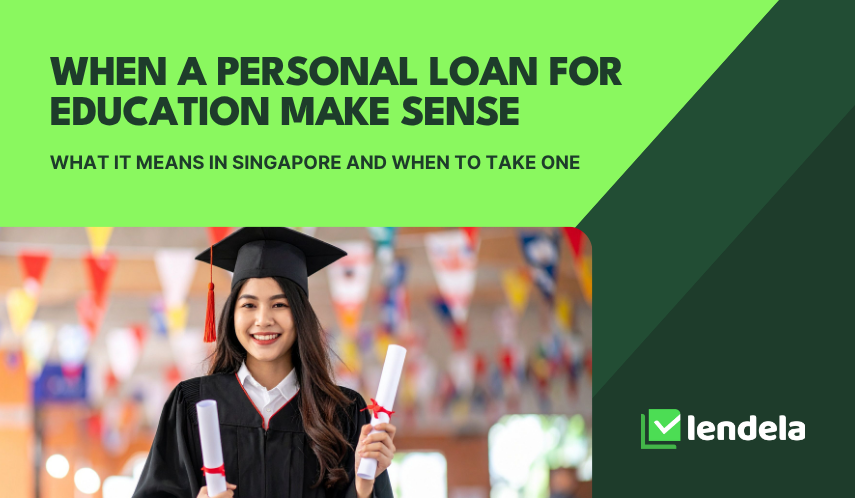
This page answers one question only: when a personal loan may make sense for education costs, when it may not, and what to compare before you use one.
Using personal loans for education?
Personal loans are unsecured loans that can sometimes be used for education-related costs.
They are usually broader and more flexible than tuition-focused financing schemes, which means they may help in situations where the cost goes beyond tuition only or where a more structured route does not fit.
That flexibility can be useful – but it also means a personal loan should be compared more carefully on cost and repayment, not treated as the default “student loan” option.
Benefits of using personal loans for education in Singapore
A personal loan for education may be useful when:
You need broader flexibility beyond tuition only
You are funding a private course, adult-learning programme, or other non-standard education cost
You need financing for non-tuition expenses such as equipment, relocation, or living support
You do not fit the eligibility rules of more structured education-financing routes
The main benefit is flexibility – not that it is automatically cheaper or better than other routes.
Drawbacks of using personal loans for education in Singapore
A personal loan can also be the wrong first move.
Common trade-offs include:
It may be more expensive than a more structured tuition-focused route
The repayment may work like a standard instalment loan rather than a study-linked scheme
Approved amount depends on your income and credit profile
Flexibility can be useful, but only if you actually need it
That is why the better question is not “Can I get a personal loan for education?” but “Do I need this flexibility badly enough to justify the cost?”.
Steps to use a personal loan for education in Singapore
If you are considering a personal loan for education, use this decision process:
1. Confirm what the financing needs to cover
Make sure the cost really goes beyond what a more structured tuition-focused route would normally cover.
2. Check whether a more structured route should come first
If your need is mainly tuition and you fit the rules, compare those routes first before defaulting to a personal loan.
3. Compare the real cost
Look at EIR/APR, monthly repayment, total payable amount, fees, and repayment period.
4. Check whether the repayment still fits your future budget
The question is not just whether the loan is approved, but whether the instalment will still be manageable once repayment begins.
5. Borrow only for a defined education need
A personal loan should support a specific plan, not become a vague fallback for every education-related cost.
Alternatives to personal loans for education in Singapore
Before using a personal loan for education, compare the broader education-financing routes first.
Common alternatives may include:
1. Government-backed tuition financing
This is often the first place to look when your main cost is eligible tuition.
2. CPF Education Scheme
This may be relevant when tuition financing is the main need and the repayment structure fits the family’s plan.
3. HESL/transitional Study Loan route
MOE’s current pages now state that the Tuition Fee Loan and Study Loan will be replaced by the Higher Education Student Loan (HESL) from 1 July 2026, so students should check which route applies based on institution and timing.
4. Bank education loans or provider instalment plans
These may offer a more structured education-focused path without using a broad personal loan.
5. Scholarships, grants, employer support, savings, or staged payment plans
These may reduce how much borrowing is needed in the first place.
If you want the full main breakdown first, read our student loan guide. If you want the side-by-side decision page, read MOE vs. bank vs. personal loan.
Education financing made simple with Lendela
Lendela is most useful when you already know you are comparing flexible loan options for education-related costs and want to review matched offers in one place.
If your need is broader than tuition only, or if a more structured education-financing route does not fit your situation, comparing matched options can be a practical next step.
If you already know you want flexible matched education-financing options, compare them here.
Wani
A veteran member of the Lendela family, Wani heads up the customer success team in Singapore and has been pivotal in the development of Lendela's highly rated customer service. Today, she oversees the growth and performance of a huge team of customer success specialists while ensuring borrowers get a fair shake on their loans.