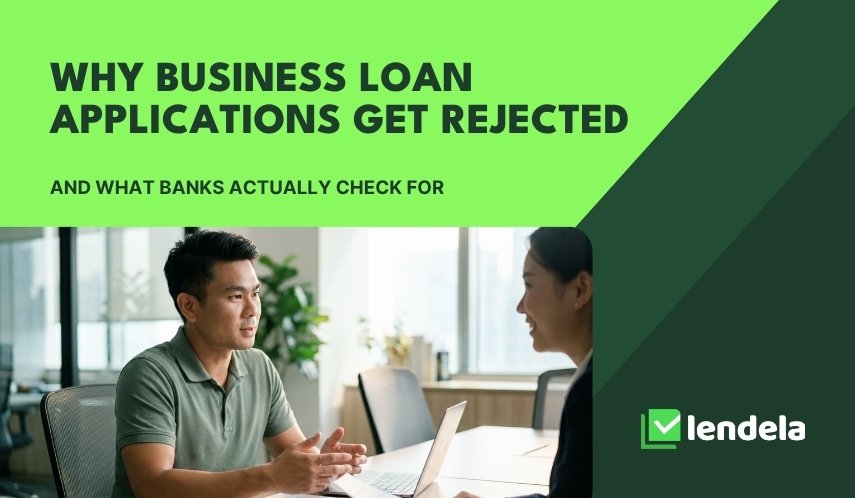
Why business loan applications get rejected in Singapore (and what banks actually check)

The Lendela Team
October 23rd, 2026
Table of contents
- Banks and financial institutions assess five things: cash flow, credit history, collateral or guarantor strength, company structure, and purpose of funds.
- Most stalled applications fail on a detail surfacing late, not on one weak number.
- A borrower group can include corporate shareholders holding more than 50 percent, which changes what a bank needs to see.
- Inconsistent documents across separate applications are a more common problem than any single missing document.
- Startups can qualify, generally with a narrower range of options; the Enterprise Financing Scheme's young-enterprise risk-share can help.
Banks and financial institutions in Singapore weigh five things before approving a business loan: cash flow and debt-servicing ability, credit history (the company's and the directors' or guarantors'), collateral or guarantor strength, company and shareholding structure, and the purpose of the funds. Most rejections, and most applications that stall after looking promising, don't come down to one weak number. They come from something surfacing late: a guarantor requirement nobody planned for, a group-structure detail that wasn't disclosed upfront, or documents that don't quite match across the application. Matching with multiple banks and financial institutions through one application, rather than approaching each separately, tends to surface these issues earlier, while they're still fixable.
At a glance, here's where approval usually gets decided and what banks typically ask to see first:
What do banks and financial institutions actually assess?
Cash flow and debt-servicing ability. Can the business cover repayments from what it actually collects, not just what it invoices? Banks look at bank statements and financial history, not projections alone.
Credit history. This covers the company's own credit record and, just as often, the personal credit history of directors and guarantors.
Collateral or guarantor strength. Unsecured facilities rely more heavily on a strong guarantor; secured facilities (equipment, property) reduce that dependence.
Company and shareholding structure. ACRA registration, group ownership, and, for government-assisted schemes such as EFS-WCL, local equity and group size.
Purpose of funds. Working capital, stock, equipment, or expansion, each points to a different type of facility.
Why do applications that look approved still stall?
A loan that looks close to approval can still stall for reasons that have little to do with the business's underlying numbers.
A guarantor requirement surfaces only once the paperwork is underway, and the proposed guarantor isn't ready or able to commit.
A group-structure detail, a corporate shareholder holding more than 50 percent, say, wasn't flagged early, and changes what the bank needs to assess.
Documents submitted to different banks don't match: a bank statement here, an older set of financials there.
The business applies to several banks separately, repeating the same submission multiple times with small inconsistencies creeping in each time.
Does your company's shareholding or group structure affect approval?
It can. For some government-assisted scheme assessments, the “borrower group” extends beyond the applicant to include corporate shareholders holding more than 50 percent and relevant subsidiaries in the ownership chain. That's why banks and financial institutions may ask for group structure and consolidated figures, not just the applying entity's own numbers. See what counts as a borrower group on Lendela's business loan page.
The shareholding threshold that pulls a corporate shareholder into the assessed borrower group works like this:
What documents trip up SME applicants most often?
Requirements vary by bank and facility, but commonly requested documents include:
ACRA BizFile or company profile
Directors' and guarantors' IDs, and shareholding or structure details where relevant
The latest 3 to 6 months of business bank statements
Latest financial statements, where available
Tax filings or Notices of Assessment, where applicable
A schedule of existing debts: outstanding facilities and monthly obligations
A short use-of-funds statement
The documents themselves rarely sink an application. What trips SMEs up is inconsistency: bank statements that don't cover a full period, a use-of-funds statement that doesn't match the facility applied for, or a guarantor's NOA that's missing entirely until a bank asks for it midway through assessment.
Does applying to several banks separately hurt your chances?
It doesn't damage a credit record on its own, but it does create more room for the inconsistencies above. Each separate application means resubmitting largely the same documents, and small differences, an updated bank statement here, a revised figure there, start to look like discrepancies rather than updates. Matching with multiple banks and financial institutions through a single application keeps the submitted information consistent across every offer a business receives, without the need to resubmit the same paperwork to each one separately.
Can a startup with limited trading history still qualify?
Yes, though the range of options may be narrower and pricing slightly higher, since banks assess risk partly on trading history. Under the Enterprise Financing Scheme, young enterprises, generally under five years old, can qualify for a higher government risk-share, which supports approval even with a shorter track record. For a fuller walkthrough of what founders should prepare, see Lendela's startup business loan guide.
Frequently asked questions
What's the single biggest reason an SME loan application gets rejected?
There's rarely one single reason. Most rejections or stalled applications trace back to a mismatch surfacing late, a guarantor who isn't ready, a shareholding detail that wasn't disclosed, or documents that don't align across submissions, rather than one weak financial figure.
Does a guarantor need to be a company director?
Not necessarily, though it's common. Requirements vary by bank and facility; some accept a qualifying shareholder or other individual as guarantor. Confirm this with the specific bank or financial institution before applying.
Can an unsecured business loan still be approved without collateral?
Yes. Many business loans and government-assisted schemes in Singapore are unsecured or collateral-free for eligible applicants, though approval still depends on cash flow, credit history, and guarantor strength.
How long does a decision take once documents are complete?
It varies by bank and the complexity of the application. With a complete set of documents, expect anywhere from a few days to a few weeks; incomplete submissions are the most common cause of delay.
Does a rejection from one bank affect my other options?
A decision from one bank doesn't automatically affect another's assessment, since each applies its own criteria. What matters more is making sure the documents and figures submitted stay consistent across every application.
What should I prepare before applying to improve my chances?
Have your ACRA BizFile, 3 to 6 months of bank statements, latest financial statements, and a short use-of-funds statement ready before you apply, and confirm your guarantor is able to commit before submission.
Compare your options
One application matches your business with 70+ banks and financial institutions, so document inconsistencies get caught before they cost you an approved offer. Compare business loan offers
Sources
The Lendela Team
Lendela is a loan-matching platform that partners with 70+ banks and financial institutions. We aim to deliver a transparent, safe, and personalised loan-matching experience, empowering borrowers with confidence to choose what truly fits. Since launching in 2018, we’ve helped hundreds of thousands of Singaporeans make smarter, more informed financial decisions through clarity and control.