More foreign workers turn to borrowing amid high cost of living in Singapore
7 min read | December 22nd, 2025
Get the complete version of this report in PDF format for easy sharing and reference.
Table of contents
Amid ongoing cost pressures and a challenging economic outlook, Lendela, a Singapore-based fintech platform, has developed a series of thematic reports uncovering how economic uncertainty and rising costs impact Singaporeans.
Lendela’s latest thematic report looks at how foreign workers in Singapore are using personal loans at a time when the city remains one of the world’s most expensive places to live.
Drawing on thousands of loan applications received on Lendela’s platform between Q3 2024 and Q3 2025, this analysis focuses on non-resident workers – a group that has grown in size and importance as Singapore’s population and workforce hit new highs.
This report is part of Lendela’s ongoing series of data-driven insights on how macro-economic conditions are reshaping borrowing behaviour in Singapore.
Key findings
Rising share of foreign workforce borrowers
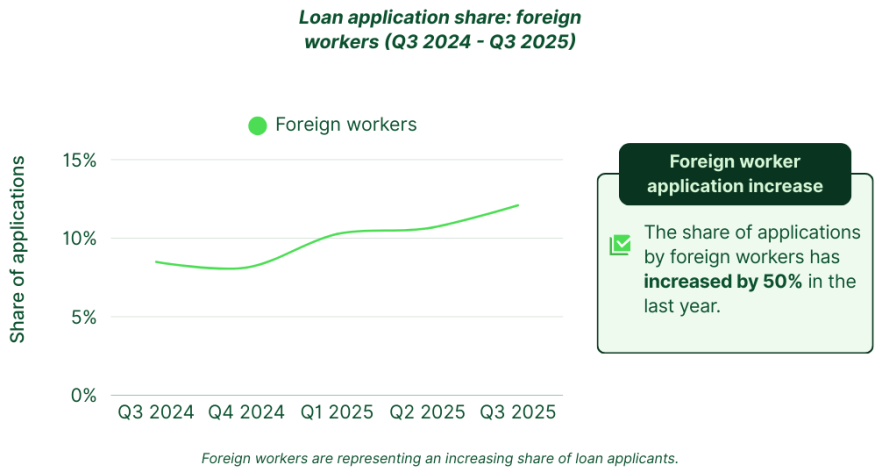
Foreign workforce applications accounted for 12% of all loan applications in Q3 2025, up from about 8% in Q3 2024 – a 50% share increase year-on-year.
Over the same period, the share of applications from Singapore citizens eased slightly (-4%), while PRs remained broadly stable.
This mirrors national labour data: recent MOM statistics show that non-resident employment growth in 2024–2025 was driven mainly by work permit holders, especially in construction and transport.
Above shift seems modest in absolute terms but meaningful from a risk and inclusion perspective: a larger slice of borrowing demand now comes from workers who are structurally more exposed to job and income volatility.
S Pass and work permit holders driving the change
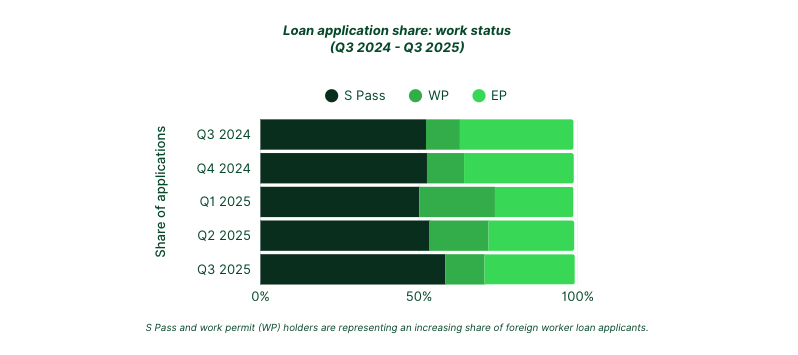
Within the foreign workforce segment, both S Pass and work permit (WP) holders were drivers of higher loan demand, consistent with official data showing foreign workforce growth concentrated in lower-wage roles.
The notable upswing in WP applications in Q1 2025 is likely tied to the non-resident employment growth in 2024 that was mainly seen among work permit holders in blue-collar roles.
The Employment Pass (EP) applicant share decreased YoY, settling on a more stable level across the last three quarters.
These observations are particularly notable given the ongoing public debate around how migrant construction and service workers continue to shoulder disproportionate cost pressures despite their essential contributions to national infrastructure and daily services.

Borrowing increasingly for necessities, not lifestyle
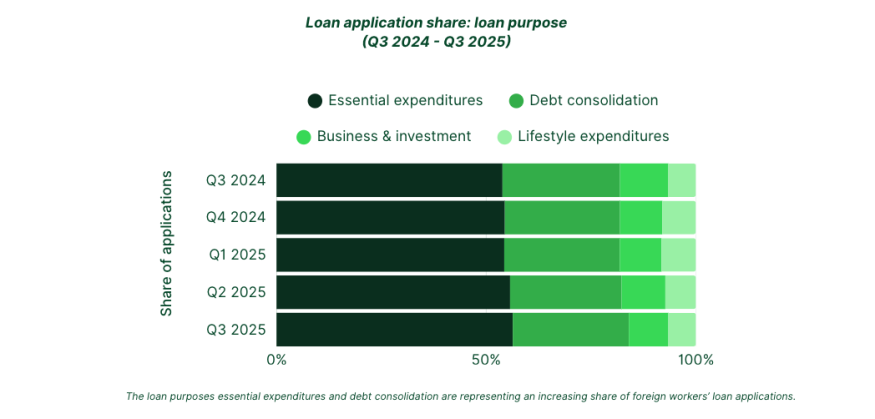
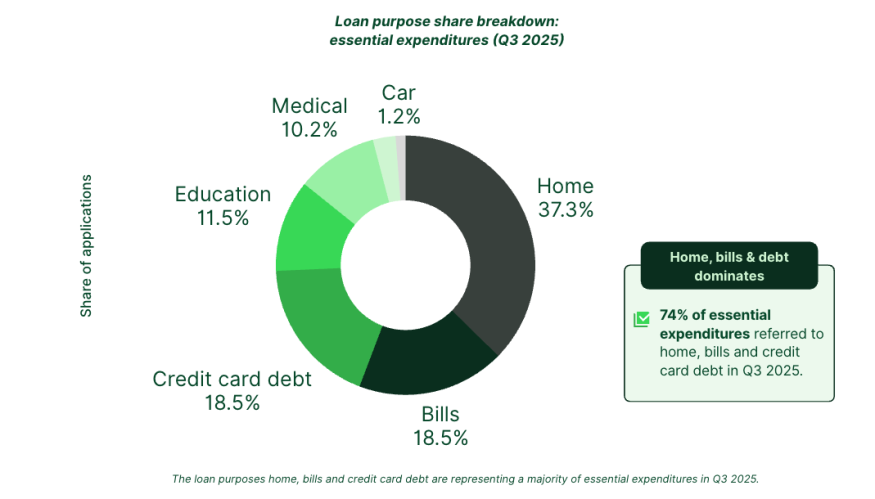
The share of essential expenditures* as a loan purpose among foreign workers rose by 5% Q3 2024 to Q3 2025.
In the last quarter (Q3 2025), essential expenditures and debt consolidation accounted for 84% of all loan applications from foreign workers.
In other words, more foreign workers are using loans to keep up with necessary spending and to consolidate existing debt, rather than to expand businesses or fund discretionary consumption. This pattern is consistent with broader narratives about household bills driving the Singapore cost of living conversation – from rental affordability to utility tariffs and transport costs.
*”Essential expenditures” in this dataset covers home, bills, credit card debt, education, medical, line of credit and car. Under “home”, mortgage payments, renovation costs and property-bridging loans are included.
Cost of living pressures remain the central story
While headline and core inflation have eased to around 0.5–1.5% in 2025, policymakers continue to highlight that households are still feeling the squeeze from earlier price increases, particularly in housing, utilities and transport.
Recent coverage notes Singapore retaining its position as one of the world’s most expensive cities, with rents, cars and day-to-day expenses staying structurally high.
For lower- to middle-income foreign workers – many paying recruitment fees, remitting money home, and absorbing higher living costs – this environment means thinner financial buffers and a greater need for short-term liquidity.
The macro backdrop: more foreign workers in an expensive city
Two macro trends frame Lendela’s findings:
1. Foreign workforce expansion
Singapore’s population reached a record 6.11 million in mid-2025, with growth primarily driven by foreign workers supporting major infrastructure and housing projects.
MOM data shows that non-resident employment gains in 2024–2025 were led by work permit holders in sectors such as construction and transport – roles typically associated with lower wage bands.
2. Persistent cost of living concerns
Even as inflation moderates, policymakers and media commentary highlight that household cost pressures remain elevated, especially for housing, utilities and everyday consumption.
Civil-society and academic voices have raised concerns about how rising living costs and recruitment fees are squeezing migrant workers’ finances, even when headline satisfaction scores remain high.
Against this backdrop, Lendela’s internal data suggests that foreign workers are not just more present in the labour market – they are also more visible in formal borrowing channels, and increasingly doing so to cope with basic costs rather than discretionary spending.
"As Singapore’s foreign workforce expands and cost pressures remain elevated, we’re seeing more non-resident workers turning to formal credit channels simply to manage essential expenses. The data shows that borrowing among foreign workers is now less about discretionary spending and more about staying afloat in a city where housing, utilities, and day-to-day costs continue to rise. It’s a reminder that access to transparent, regulated lending isn’t just a convenience — it’s becoming a critical financial safety valve for a segment that plays a vital role in keeping the country running”, said Axel Frändén, Deputy CEO of Lendela.
Interpreting the signal: resilience, risk and inclusion
Although Lendela’s data is specific to personal loan applications, a few broader themes emerge:
Inclusion in formal credit channels
The growing share of foreign worker borrowers suggests more non-residents are turning to regulated financial channels rather than informal lenders – a positive development from a consumer protection standpoint.
For lenders, this creates an opportunity to design products with clearer risk-based pricing and safeguards instead of leaving this demand to unregulated actors.
Thin buffers amidst structural cost pressures
Loans for home-related costs, bill payments and card debt point to foreign workers trying to smooth cash flow rather than over-stretch on lifestyle.
Against a backdrop where policymakers are allocating additional U-Save rebates and cash hand-outs to help households cope with expenses, foreign workers – who may not benefit fully from such schemes – appear to be bridging gaps through borrowing.
Borrowing to stay afloat, not move ahead
Compared with earlier Lendela reports where business owners shifted from growth to survival borrowing, foreign workers now show a similar pattern: borrowing is increasingly defensive, focused on basic stability rather than upward mobility.
“What we’re seeing in our data is not foreign workers taking on risky bets or splurging. They are borrowing to keep up with essential expenses in an environment where costs remain high and buffers are thin”, said Axel Frändén.
“As Singapore’s workforce becomes more reliant on non-resident labour, it’s critical that access to credit for this group is fair, transparent and anchored in responsible lending”, Frändén concluded.
The data in this report is based on a study of tens of thousands of loan applications received over the period between 1 July, 2024 and 30 September, 2025. Percentages reported refer to share of total applications or share within the foreign-worker segment, not absolute volumes. Loan purposes are self-declared by applicants and grouped into broader categories for analytical clarity. All data is anonymised and aggregated; no individual borrower or lender is identifiable.
The quarterly report is brought to you by Lendela. If it is of interest to you, please get in touch with us at [email protected].