
The Lendela Team
October 7th, 2026
Table of contents
- A 'flash sale' ran for nearly two years under rotating names, according to Singapore's consumer regulator, CCS. It was advertised as 'up to 40% off'.
- Singapore's pricing guidelines say a discount should be measured against a price the seller has genuinely charged for a reasonable length of time. CCCS has found cases where the 'usual price' shown was never actually offered.
- CCS found fake visitor counts, 'reserved' timers with no effect on checkout, and 'almost sold out' labels with no stock behind them. These were individual retailers' own websites, and all three May 2026 retailers gave undertakings and stopped.
- Pay-later is under 2% of the value of card payments, and the vast majority of users with missed payments owe under $1,000 (MAS, February 2026). The issue is how several small plans stack into a fixed monthly bill.
- There's no official guideline for how much of your pay should go to instalments. A simple gauge: add up monthly instalments, divide by take-home pay, and set your own ceiling before the sale.
A sale price is made of more than one number. The crossed-out price, the percentage off, the countdown timer and the “almost sold out” label each say something, and each leaves something out. Singapore's consumer regulator, the Competition and Consumer Commission of Singapore (CCS), has spent the past year publishing cases where those signals weren't real: visitor counts that were randomly generated, “reserved” timers that reserved nothing, “almost sold out” labels on made-to-order stock, and a “flash sale” that ran for nearly two years under rotating names.
None of that is a reason to skip 11.11, which falls on Wednesday 11 November 2026. It's a reason to read a sale price one part at a time, and to ask a simple question before the percentage decides for you: was the crossed-out price ever the price? The cases below involved individual retailers' own websites, not the big sale-day platforms, and every retailer in the May 2026 cases has since agreed to stop.
We also look at pay-later, which tends to travel with sale-day carts. The official picture from MAS is that it's still a small share of spending, and the vast majority of users with missed payments owe under $1,000. The practical issue is how several small plans stack into a fixed monthly bill, so we include a simple way to work out your own instalment share. All figures are sourced and dated, as at October 2026.
What's actually in a sale price?
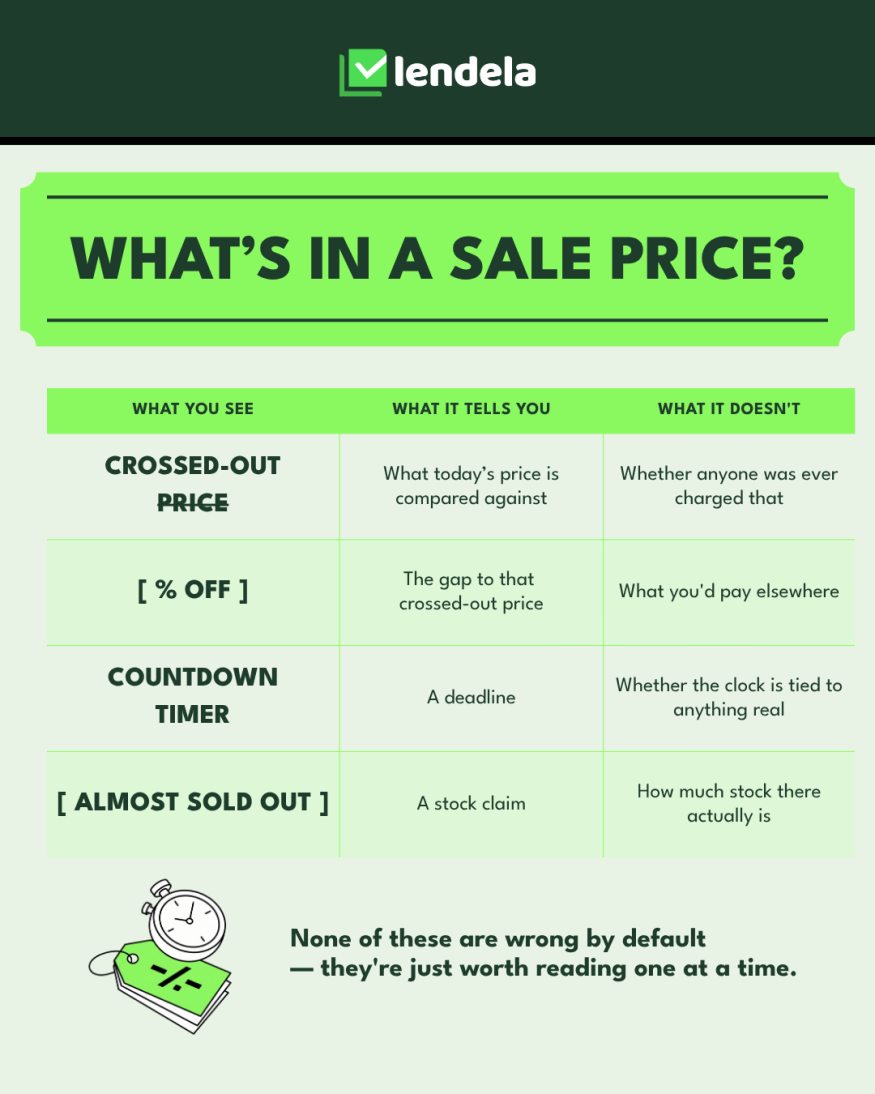
When a listing says “60% off”, that number is doing several jobs at once. It compares today's price to another price, it often sits beside a clock, and it may come with a stock warning. Each of those tells you something, and each one leaves something out.
What you see | What it tells you | What it doesn't |
|---|---|---|
Crossed-out price | What today's price is compared against | Whether anyone was ever charged that |
% off | The gap to that crossed-out price | What you'd pay elsewhere |
Countdown timer | A deadline | Whether the clock is tied to anything real |
Almost sold out | A stock claim | How much stock there actually is |
None of these are wrong by default. A real crossed-out price, a real deadline and a real stock warning are all useful. They're just worth reading one at a time, because a percentage is only as good as the price it's measured against.
Was the crossed-out price ever the price?
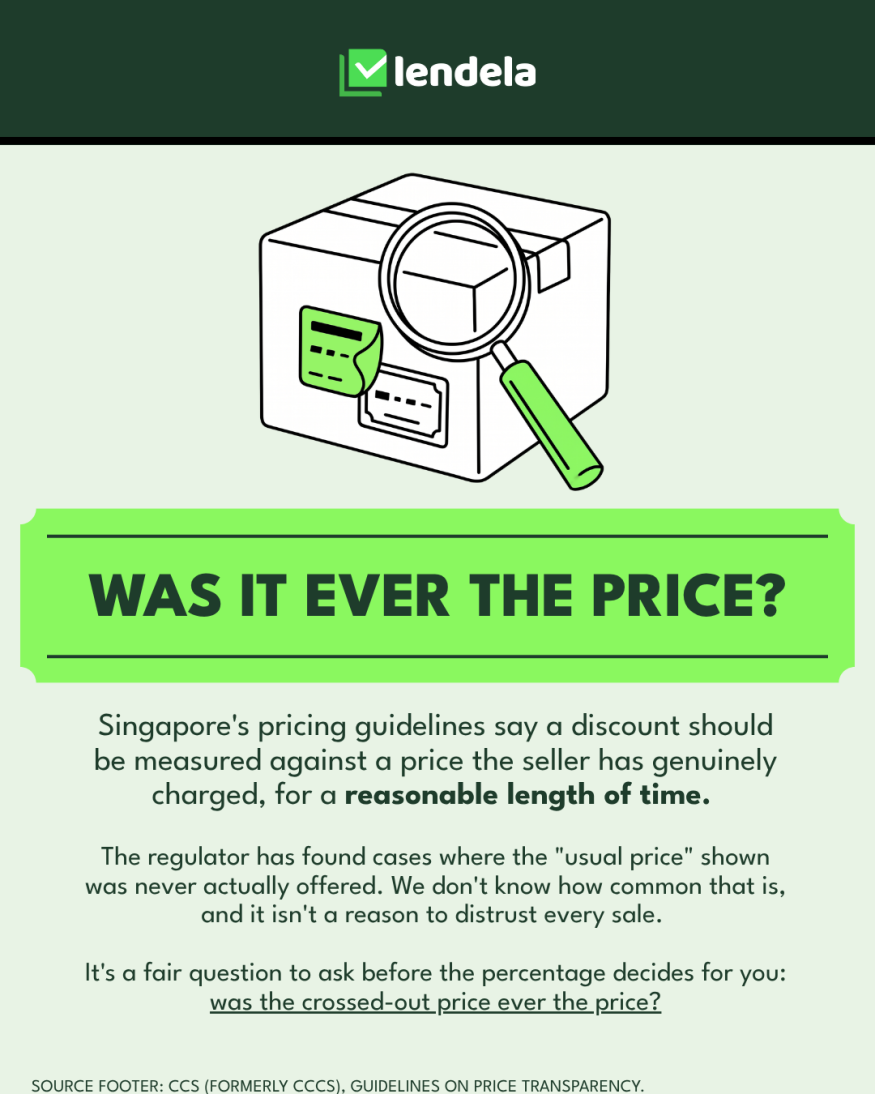
Singapore's Guidelines on Price Transparency, issued by CCS when it was still called CCCS, say that when a seller compares a discount with a previous price to show a price benefit, it should use a bona fide previous price: one the seller has genuinely charged, for a reasonable length of time.
Two cases show the rule being applied. In early 2025, CCCS found that none of the “usual prices” shown for several OSIM products between 1 January 2022 and 14 May 2023 were actually offered to customers over that period. OSIM gave an undertaking and ensured its promotions reflected actual discounts. In May 2026, CCS found that Light In The Box showed discounted prices against higher “original” prices that were never actually offered.
We don't know how common this is. Enforcement cases show that a practice exists and has been acted on, not how often it happens, and we found no Singapore dataset that measures it. It isn't a reason to distrust every sale, and it isn't limited to small sellers: OSIM is a well-known consumer brand. It's a fair question to ask before the percentage decides for you: was the crossed-out price ever the price?
A quick check is to compare the same item across a few sellers, and to see whether a brand's own website shows the same “original” price.
Are countdown timers and “almost sold out” labels real?
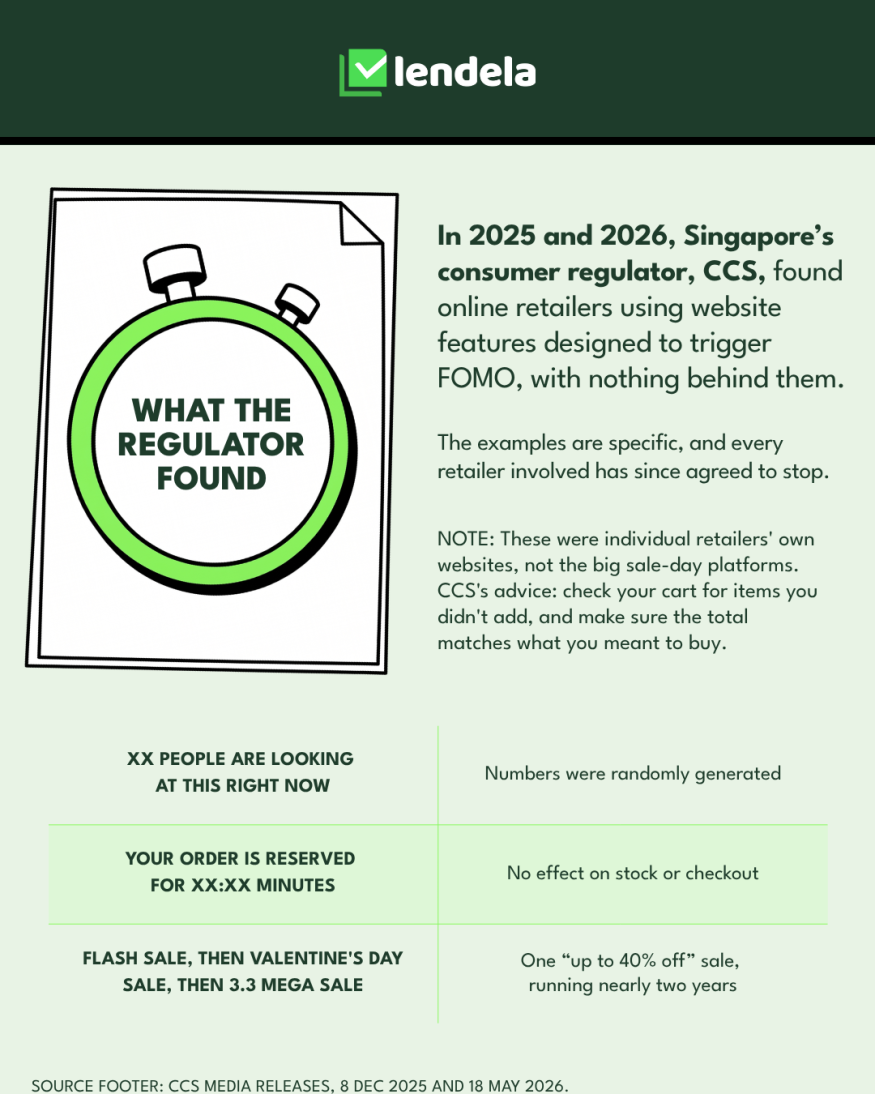
Sometimes they are, and sometimes the label is decoration. We can't say how often, but CCS has published what it found and where. Every case below involved an individual retailer's own website, and all three retailers in the May 2026 release gave formal undertakings to CCS and stopped.
Retailer | What CCS found | CCS release |
|---|---|---|
Boarding Gate (operated by Seager Inc.) | Numbers showing how many people were looking at a product or had it in their carts were randomly generated, according to the website's source code | 18 May 2026 |
Origin Sleep | Cart activity claims with no evidence behind them, and a “reserved” countdown timer with no effect on availability or checkout. An “up to 40% off” flash sale continued for nearly two years under rotating names: a Flash Sale in January, then a Valentine's Day Sale, a CNY Sale, a 3.3 Mega Sale, and so on | 18 May 2026 |
Light In The Box | “Almost sold out” labels on a made-to-order business with minimal or no standing inventory, applied randomly for promotional effect, and discounts shown against “original” prices that were never actually offered | 18 May 2026 |
PRISM+ | Countdown timers on checkout pages that weren't linked to any inventory system, and “In Stock: Running Low” shown on any product with more than 100 units, a threshold not disclosed to shoppers. For one product, monthly sales were only 7% of total stock. Inflated discount claims were also flagged | 8 December 2025 |
Courts | Automatically added unsolicited items to shoppers' carts during promotional periods | 8 December 2025 |
These are CCS's findings, as published in its own releases. CCS also made a point that applies to every online seller: one retailer said its website came from a template bought from an overseas vendor, and CCS said businesses cannot disclaim responsibility to consumers whether they bought a third-party template or designed the site themselves.
CCS's advice after the Courts case was to check your cart for items you didn't add, and to make sure the total at payment matches what you meant to buy. If you come across a misleading practice, you can report it to the Consumers Association of Singapore (CASE) on 6277 5100 or through its online complaints portal. CASE's president said CASE received 369 complaints involving misleading or false claims and misleading website features in 2025, according to The Straits Times.
How does pay-later add up?
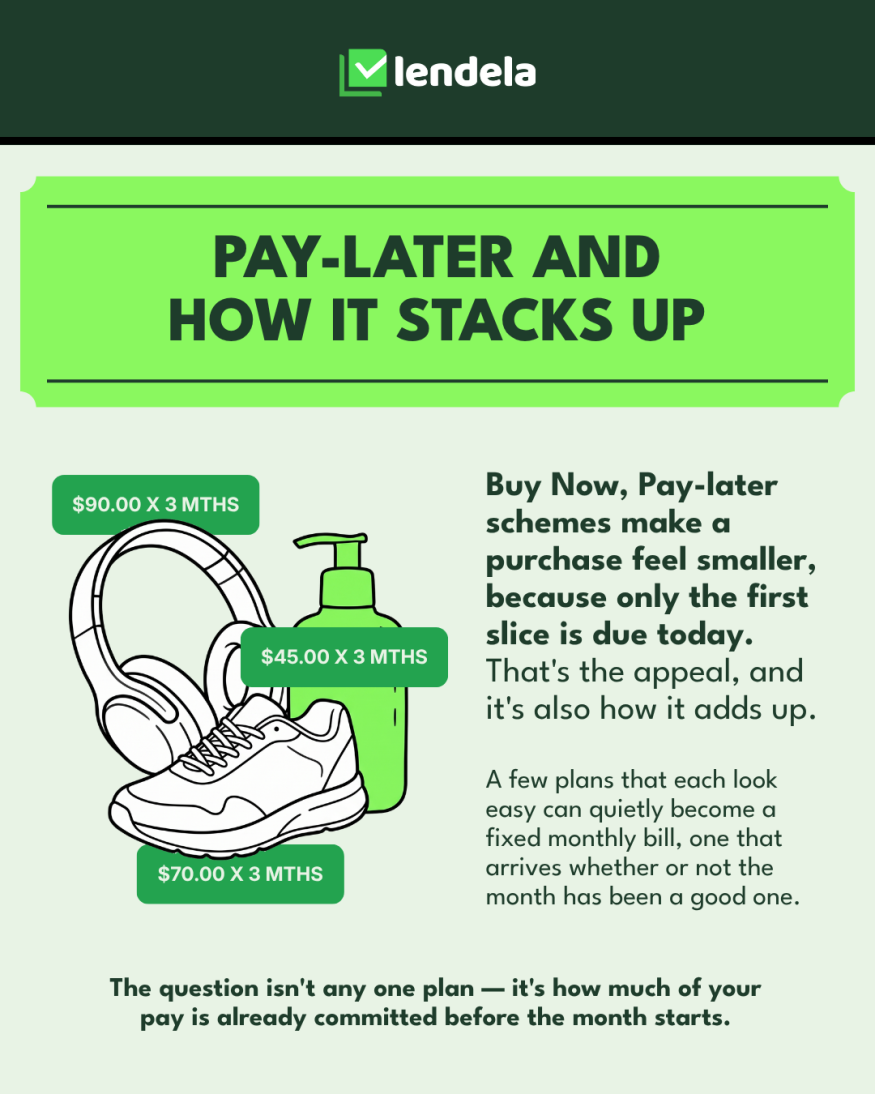
Pay-later, or buy now, pay later (BNPL), makes a purchase feel smaller, because only the first slice is due today. That's the appeal, and it's also how it adds up. A few plans that each look easy can quietly become a fixed monthly bill, one that arrives whether or not the month has been a good one. The question isn't any one plan. It's how much of your pay is already committed before the month starts.
In a written reply to Parliament on 4 February 2026, MAS said BNPL accounted for less than 2% of the value of credit and debit card payments in the first half of 2025, and that 1.5% of BNPL customers were under 21. For users with missed payments, the median amount outstanding across all BNPL firms was under $400, and the vast majority owed under $1,000. MAS said BNPL firms have committed to an industry code: they cap and clearly disclose late fees, don't charge compound interest on outstanding amounts, and don't grant limits above $2,000 without additional credit assessments, including BNPL credit bureau checks. A user's BNPL facility is suspended once a payment is overdue. MAS said there was no need for further measures at this time, and that it would continue to monitor.
Here is what stacking looks like, using illustrative figures:
Item | Total | Monthly, in 3 payments |
|---|---|---|
Headphones | $270 | $90 |
Sneakers | $210 | $70 |
Skincare set | $135 | $45 |
Together | $615 | $205 a month |
These figures are illustrative. On a take-home pay of $3,500, $205 a month is about 6% of your pay, committed before the month begins.
How do you work out your own pay-later limit?
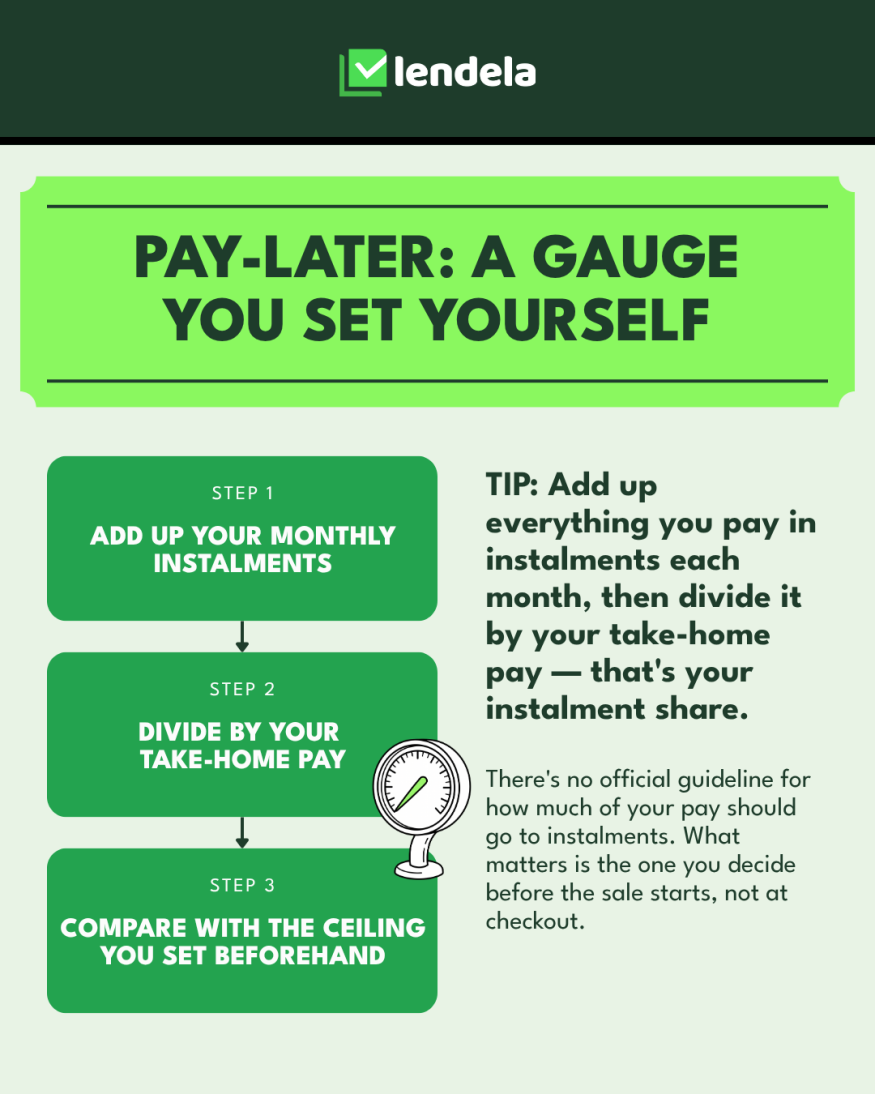
There's no official guideline for how much of your pay should go to pay-later instalments. So the number that matters is the one you decide before the sale starts, not the one you work out at the checkout. A simple way to get there is your instalment share. Each app only shows its own plans, so the total across all of them, plus any card instalment plans, is yours to add up.
Step | What to do | Using the example above |
|---|---|---|
1 | Add up your monthly instalments | $205 |
2 | Divide by your take-home pay | $205 ÷ $3,500 |
3 | Compare with the ceiling you set beforehand | About 6% |
To see what a share looks like in dollars, here are three examples. We're not calling any of them safe, because that depends on your own situation.
Take-home pay | 5% | 10% | 20% |
|---|---|---|---|
$3,000 | $150 | $300 | $600 |
$4,500 | $225 | $450 | $900 |
$6,000 | $300 | $600 | $1,200 |
For context only, the official ratios that exist cover different things. MAS's Total Debt Servicing Ratio caps total monthly debt repayments at 55% of gross monthly income when you take a property loan, and the Mortgage Servicing Ratio caps HDB and EC loan repayments at 30% of gross monthly income, according to MoneySense. These are ceilings for loan providers on property loans. They aren't a measure of what's comfortable for a pay-later habit, and they use gross income, whereas the gauge above uses take-home pay. Late fees are capped and shown up front, but they still apply, so it's worth knowing the fee before you tick the box.
So what should you check before you pay?
Was the crossed-out price ever the price? Compare the same item across a few sellers.
Does the timer or stock warning change anything? Check whether the price is still there after the clock ends.
Is anything in your cart that you didn't add, and does the total match what you meant to buy?
If you're using pay-later, what's the late fee, and what's your instalment share across all your plans?
None of this means skipping the sales. It just means going by the price, not the clock around it. A price that's good today usually still looks good after you've taken a minute to check it.
The same question works for borrowing. A monthly figure is the headline; the total you repay across the full tenure is the real price. If you're carrying card balances or loans and want to see what a single repayment plan would cost in total, Lendela lets you compare offers from 70+ licensed lenders through one form, without affecting your credit score.
Rates are personalised estimates, so check the total repayment and tenure before you decide. See what you qualify for →
The same exercise works across almost anything worth budgeting for in Singapore. We've added up what mooncake season actually costs, where the packaging turns out to be most of the price, and what ten years did to the cost of living here.
Frequently asked questions
When is 11.11 in 2026? 11.11 falls on Wednesday 11 November 2026. Black Friday follows on 27 November and Cyber Monday on 30 November.
What are dark patterns in online shopping? Dark patterns are misleading website design features that pressure shoppers into quick purchase decisions. Singapore's consumer regulator, CCS, used the term for fake visitor counts, fabricated countdown timers, false scarcity labels and false discount claims it found on some online retailers' websites in 2025 and 2026.
Are countdown timers on sale websites always real? Not always. CCS found retailers using countdown timers and reserved-for-you messages that had no effect on stock or checkout. That does not mean every timer is fake, but a timer is only useful if it is tied to a real deadline, so it is worth checking whether the price actually changes when the clock ends.
How do I know if a crossed-out price is genuine? Singapore's pricing guidelines say a discount should be measured against a price the seller has genuinely charged for a reasonable length of time. The regulator has found cases where the usual price shown was never actually offered. You can't confirm it from the listing alone, so comparing the same item across a few sellers is a quick check.
Do the CCS cases involve the big 11.11 platforms? No. The retailers named in CCS's December 2025 and May 2026 releases were individual retailers' own websites: Courts, PRISM+, Boarding Gate, Origin Sleep and Light In The Box.
How does buy now, pay later work in Singapore? Buy now, pay later lets you split a purchase into instalments, with only the first slice due on the day. MAS told Parliament in February 2026 that BNPL is under 2% of the value of card payments, that the median user with missed payments owes under $400, and that BNPL firms cap and disclose late fees, don't charge compound interest and don't grant limits above $2,000 without additional credit assessments.
How much of my pay should go to pay-later instalments? There is no official guideline for pay-later. A simple gauge is your instalment share: add up every monthly instalment across all apps, divide by your take-home pay, and compare it with a ceiling you set before the sale starts. MAS's 55% Total Debt Servicing Ratio and 30% Mortgage Servicing Ratio apply to property loans and are not a guide for pay-later.
Where can I report a misleading sale practice in Singapore? You can report it to the Consumers Association of Singapore (CASE) on 6277 5100 or through its online complaints portal at complaints.case.org.sg.
Sources
Competition and Consumer Commission of Singapore (CCS), media release, 18 May 2026, Three Online Retailers Caught Using False Urgency Tactics and Misleading Claims to Pressure Shoppers
CCS, media release, 8 December 2025, CCS Takes Action against Courts and PRISM+ for Misleading Website Features
CCCS (now CCS), media release, CCCS Raises Concerns with OSIM's Product Information Transparency and Pricing
CCCS (now CCS), Guidelines on Price Transparency
Monetary Authority of Singapore (MAS), written reply to Parliamentary Questions on Buy Now, Pay Later transactions, 4 February 2026
MoneySense, Total Debt Servicing Ratio and Mortgage Servicing Ratio
AsiaOne, 18 May 2026, and The Straits Times (via ANN), 18 May 2026, reporting on the CCS cases and CASE complaint figures
Figures verified as at October 2026. Prices, regulations and pay-later terms can change, and your own situation will differ, so please treat this as general information and not financial advice, and check directly with the seller or provider before making any decision.
The Lendela Team
Lendela is a loan-matching platform that partners with 70+ MAS-licensed lenders. We aim to deliver a transparent, safe, and personalised loan-matching experience, empowering borrowers with confidence to choose what truly fits. Since launching in 2018, we’ve helped hundreds of thousands of Singaporeans make smarter, more informed financial decisions through clarity and control.