The Real Price of a Baby's First Year, Part 2: $62,000 Per Child, and When It Starts

The Lendela Team
October 22nd, 2026
Table of contents
- The SG Child Support Package is worth up to $62,000 per child and starts paying out in April 2027. Babies born before then move across from the Baby Bonus automatically.
- Parents can share up to 30 weeks of paid leave: 16 weeks of maternity, 4 of paternity and 10 of shared parental leave, for babies born from 1 April 2026.
- Anchor-operator infant care is capped at $1,235 a month before subsidy. After subsidy, a working mother pays about $135 to $635 a month depending on household income.
- A domestic helper costs about $950 to $1,650 a month with no subsidy. Infant care is cheaper for most eligible families, but covers one child during fixed hours.
- The childcare subsidy income ceiling rises to $15,000 on 1 January 2027. Fee cuts follow progressively from 2028, with details on full subsidies due in early 2027.
New parents in Singapore can share up to 30 weeks of paid leave between them, a new SG Child Support Package worth up to $62,000 per child that starts paying out in April 2027, and subsidised infant care that can bring a $1,235 monthly fee down to about $135, depending on household income. The dates are staggered, so which year your baby is born in changes what you receive and when.
A baby born before April 2027 isn't left out. Children enrolled in the Baby Bonus Scheme keep receiving it until 31 March 2027, then move across to the new package automatically, with a top-up to $10,000 by 30 April 2027 where applicable. The one practical task is to link your child's PayNow to a bank account, so the payouts have somewhere to go.
This is Part 2 of a two-part episode of The Real Price Of. Part 1 covers fertility treatment, pregnancy, delivery and confinement. This part covers what the first year looks like once the baby is home: leave, the new package, infant care, and the helper question. Figures come from LifeSG, MOM, MSF and ECDA, as at October 2026, and anything not yet announced is marked as such.
When does the $62,000 SG Child Support Package start paying out?
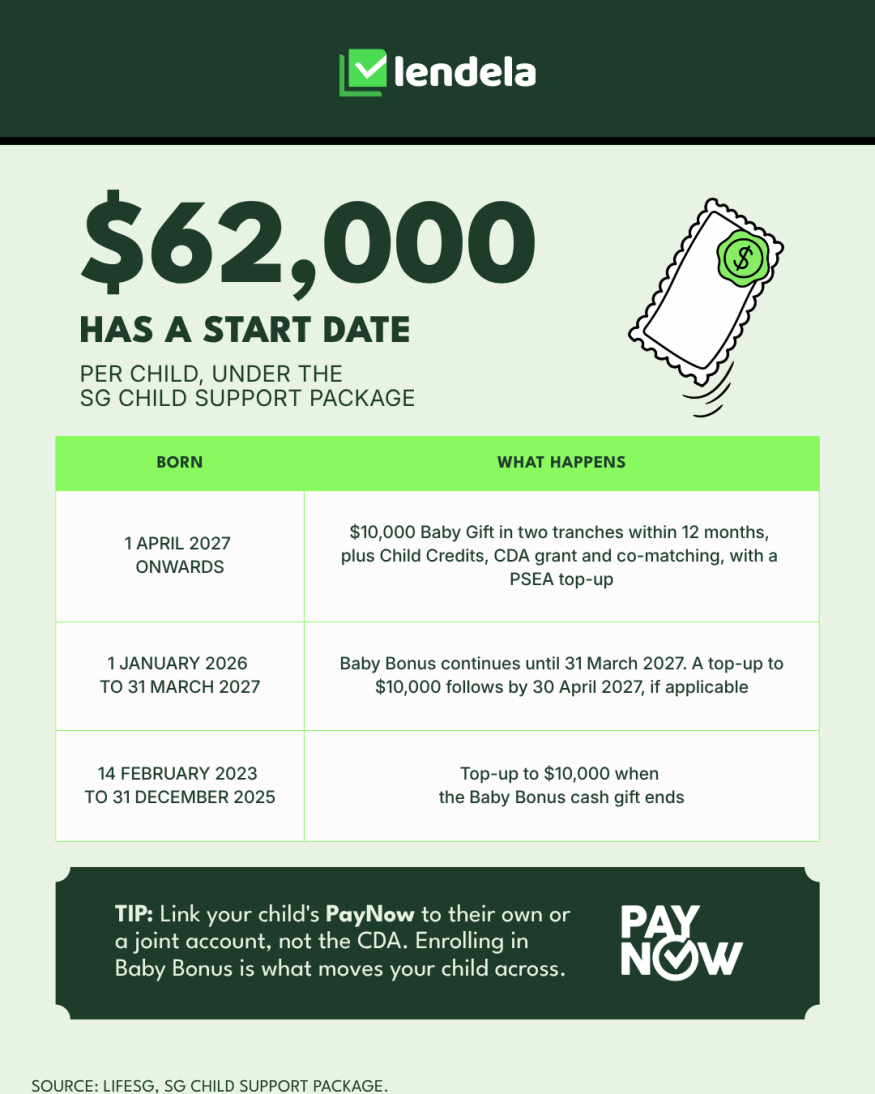
At National Day Rally 2026, the government announced the SG Child Support Package, which replaces the Baby Bonus Scheme. It's worth up to $62,000 per Singapore citizen child, or around $70,000 once the existing $5,000 MediSave Grant for Newborns and around $2,500 in Edusave contributions are added. The amount is the same for every child, whatever the birth order, and payouts start from April 2027.
Here is what the $62,000 is made of:
Component | Amount | How it's paid |
|---|---|---|
Baby Gift | $10,000 | Cash, in two tranches within 12 months of birth |
Child Credits | $2,000 a year, ages 1 to 16 (up to $32,000) | Cash each year, with the first payout in April 2027 and later ones on the child's birthday |
CDA First Step Grant | $5,000 | Into the Child Development Account (CDA), once it's opened |
CDA co-matching | Up to $5,000, dollar for dollar | Matches what you save in the CDA, with the $5,000 cap applying from 1 October 2027 |
PSEA top-up | $10,000 | One-off, into the Post-Secondary Education Account, in the year the child turns 17 |
Total | $62,000 | Over 17 years |
These amounts apply in full to babies born from 1 April 2027. For babies born earlier, some parts follow the existing Baby Bonus amounts, such as the CDA First Step Grant, and the transition works like this:
Born | What happens |
|---|---|
1 April 2027 onwards | $10,000 Baby Gift in two tranches within 12 months, plus Child Credits, CDA grant and co-matching, and a PSEA top-up |
1 January 2026 to 31 March 2027 | Baby Bonus continues until 31 March 2027. A top-up to $10,000 follows by 30 April 2027, if applicable |
14 February 2023 to 31 December 2025 | Top-up to $10,000 when the Baby Bonus cash gift ends |
Children who aren't enrolled in the Baby Bonus Scheme yet can still enrol. Enrolling is what moves your child across to the new package from April 2027.
There's one piece of admin before the first payout: your child's PayNow. Payouts go to the bank account linked to it, and LifeSG advises setting it up before 1 April 2027 to avoid delays.
Step | What to do |
|---|---|
1 | Make sure your child has a bank account, either in their own name or a joint account with a parent |
2 | Link that account to your child's PayNow ID, which is their NRIC or birth certificate number, in your bank's app |
3 | Don't link it to the CDA, which is for approved uses and isn't a regular bank account |
How much paid leave do parents get in the first year?
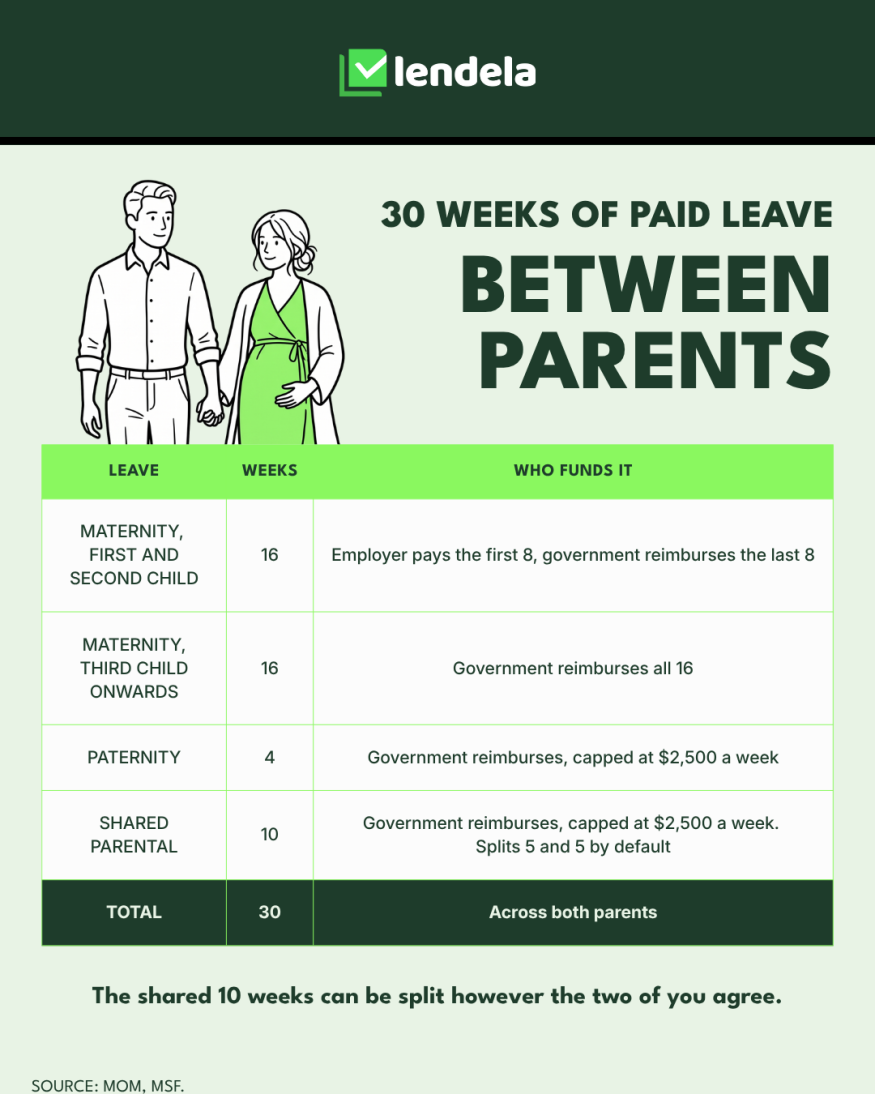
A baby born to Singapore citizen parents opens up to 30 weeks of paid leave between the two of them: 16 weeks of maternity leave, 4 weeks of paternity leave, and 10 weeks of shared parental leave for babies born from 1 April 2026. Salary continues throughout. What differs is who funds each part.
Leave | Weeks | Who funds it | Reimbursement cap |
|---|---|---|---|
Maternity, first and second child | 16 | Employer pays the first 8, government reimburses the last 8 | $10,000 for every 4 weeks reimbursed |
Maternity, third child onwards | 16 | Government reimburses all 16 | $10,000 for every 4 weeks reimbursed |
Paternity | 4 | Government reimburses | $2,500 a week |
Shared parental | 10 | Government reimburses. Splits 5 and 5 by default | $2,500 a week |
Total | 30 | Across both parents |
The caps limit what an employer can claim back, not the leave you're entitled to, and they include CPF. The shared 10 weeks can be split however the two of you agree, and the rules for doing so are worth knowing before the baby arrives:
Shared parental leave rule | What it says |
|---|---|
Who it applies to | Babies born from 1 April 2026. Babies born from 1 April 2025 to 31 March 2026 get 6 weeks |
Default split | 5 weeks each, or any other split you both agree |
When to use it | Within 12 months of the baby's birth |
Telling the government | Submit your sharing arrangement through LifeSG within 4 weeks of the birth. Changes after that need your employer's agreement |
If you don't agree on a split | The leave is taken as one continuous block within the baby's first 26 weeks, after 4 weeks' notice to the employer |
Two further changes were announced at NDR 2026, and neither has a start date yet. The government will cover the part of child-related leave that employers pay today, and childcare leave and extended childcare leave will merge into one scheme of 8 to 12 days a year, depending on the number of children aged 12 and below, fully government-funded.
How much does infant care cost after subsidy?
What a centre is allowed to charge and what a family actually pays are two different numbers once subsidies are applied. Government-supported centres cap their fees, and the cap is the starting point:
Centre type | Infant care, full-day | Childcare, full-day |
|---|---|---|
Anchor operator | $1,235 a month | $610 a month |
Partner operator | $1,290 a month | $650 a month |
Private or premium | About $1,800 to $2,500 or more, not capped | About $1,580 to $2,500 or more, not capped |
These are before GST and before subsidy. The subsidy has two parts, and the first depends on whether the mother is working:
Subsidy | Working mother | Non-working mother |
|---|---|---|
Basic Subsidy, infant care | $600 | $150 |
Additional Subsidy, infant care | Up to $710, means-tested | Not available |
Basic Subsidy, childcare | $300 | $150 |
Additional Subsidy, childcare | Up to $467, means-tested | Not available |
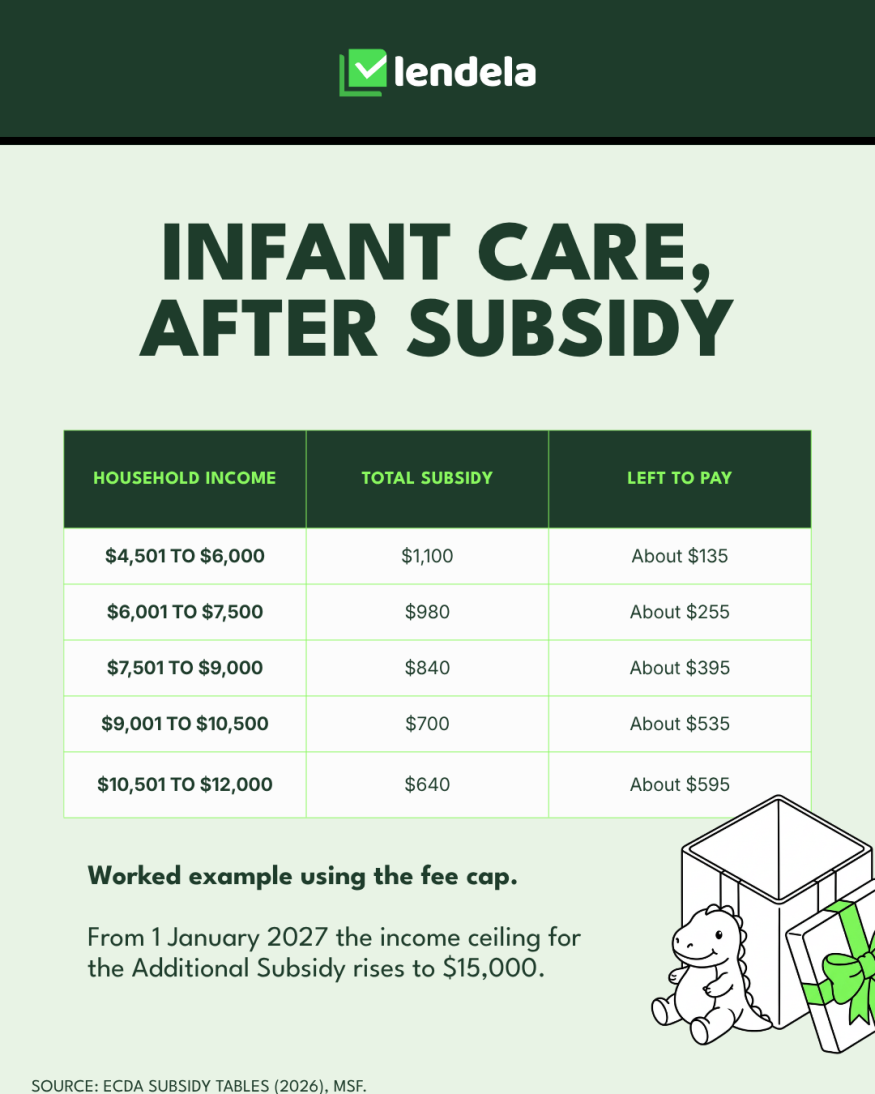
The Additional Subsidy shrinks as household income rises, and it's available for gross monthly household income of $12,000 or below today. Taking the anchor-operator infant care cap of $1,235 and subtracting the subsidy for each income band gives a worked example of what's left to pay:
Household income | Basic plus Additional Subsidy | Left to pay each month | Over 12 months |
|---|---|---|---|
$4,501 to $6,000 | $1,100 | About $135 | About $1,620 |
$6,001 to $7,500 | $980 | About $255 | About $3,060 |
$7,501 to $9,000 | $840 | About $395 | About $4,740 |
$9,001 to $10,500 | $700 | About $535 | About $6,420 |
$10,501 to $12,000 | $640 | About $595 | About $7,140 |
Above $12,000 | $600 (Basic only) | About $635 | About $7,620 |
A few things to keep in mind when reading that table. It's a worked example, not a quote: your centre's actual fee, GST and your own income band will change the number, and registration fees and deposits come on top. The lowest-income families pay a small minimum co-payment even when the subsidy exceeds the fee. ECDA's own worked example shows a $3 minimum co-payment on a childcare fee.
Two changes matter for what comes next. From 1 January 2027, the income ceiling for the Additional Subsidy rises from $12,000 to $15,000 of gross monthly household income, which is expected to benefit more than 60,000 families. The Straits Times gave a childcare example: a household earning $12,500 with two children in anchor-operator childcare would see combined out-of-pocket fees fall 35%, from $730 a month in 2026 to $470 in 2027. The subsidy amounts for the $12,001 to $15,000 band haven't been published yet. Separately, since December 2024, families with a Singapore citizen child in childcare and gross monthly household income of $6,000 or below qualify for full childcare subsidies regardless of the main applicant's working status.
Fees themselves are set to fall as well. NDR 2026 set targets of $150 a month for childcare and $300 a month for infant care by 2030, before means-testing, with reductions rolling out progressively from 2028. Full subsidies for all families regardless of working status will follow, with details due in early 2027. None of that is live today, and it shouldn't be mistaken for the figures in the table above.
Is a domestic helper cheaper than infant care?
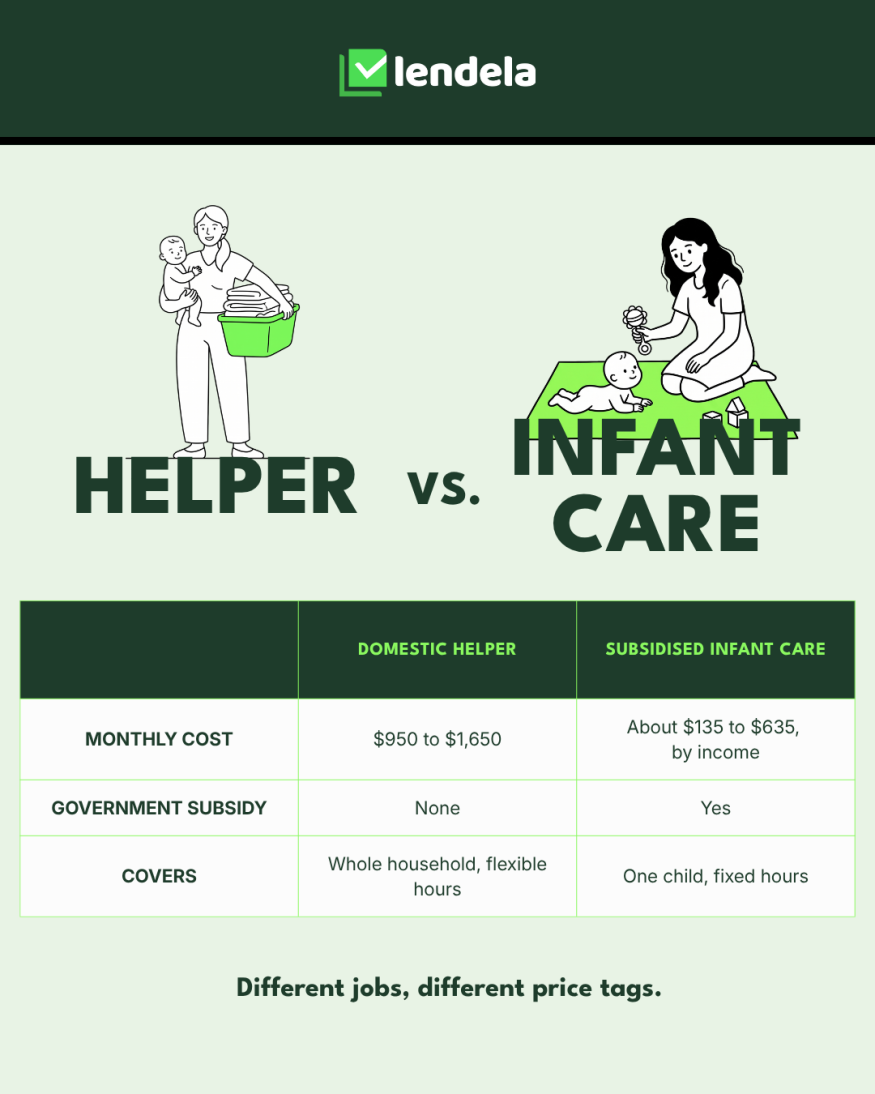
On paper, usually yes for the monthly figure, but the two don't do the same job. A helper covers the whole household at any hour and can look after more than one child. Infant care covers one child during fixed centre hours. Many families end up weighing both rather than choosing one.
What you're comparing | Domestic helper | Subsidised infant care |
|---|---|---|
Monthly cost | $950 to $1,650 | About $135 to $635, by income |
Upfront costs | About $1,000 to $8,000 (agency fee, insurance, medical, airfare for an overseas hire) | Registration fee and deposit, which vary by centre |
First year, roughly | About $11,500 to $22,000 including upfront costs | About $1,620 to $7,620 in monthly fees |
Government subsidy | None | Yes, Basic and Additional Subsidies |
Covers | Whole household, flexible hours, more than one child | One child, fixed centre hours |
Commitment | Two-year work permit | Month-to-month enrolment, subject to waitlists |
Here's what sits inside that helper range, so you can see where it moves:
Helper cost component | Typical monthly amount |
|---|---|
Salary | $550 to $1,000 |
Foreign worker levy | $60 at the concessionary rate for households with a child under 16, or $300 at the standard rate |
Food, insurance and upkeep | About $120 to $400 |
Monthly total | $950 to $1,650 |
There's no official benchmark for what a helper costs, so these helper figures are estimates drawn from agency and comparison-site guides, and they vary with nationality, experience and agency. The infant care figures come from the subsidy table above. Treat the helper range as a guide, and check with an agency for a real quote.
What's in place now, and what's still coming?
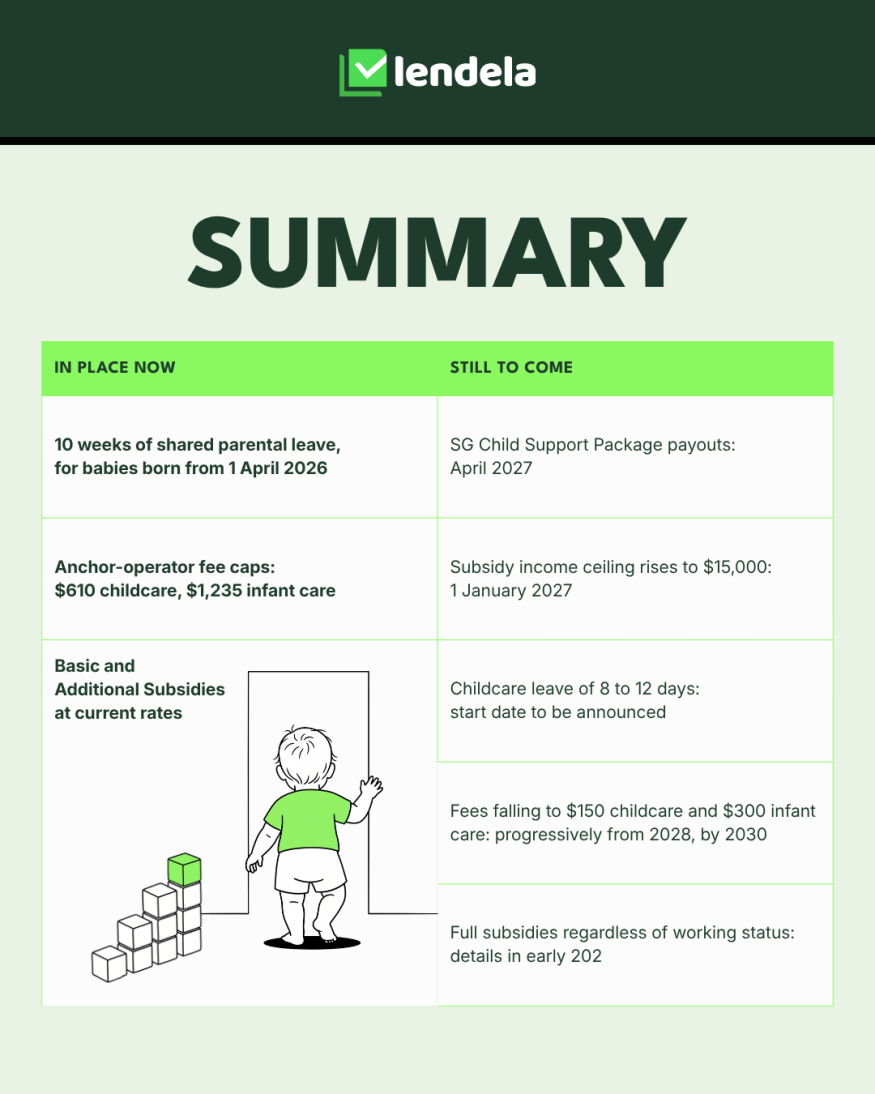
Plenty has changed, and plenty is still on its way. Here's the split between what's live and what you'll be waiting for:
In place now | Still to come |
|---|---|
10 weeks of shared parental leave, for babies born from 1 April 2026 | SG Child Support Package payouts: April 2027 |
Anchor-operator fee caps: $610 childcare, $1,235 infant care | Subsidy income ceiling rises to $15,000: 1 January 2027 |
Basic and Additional Subsidies at current rates | Childcare leave of 8 to 12 days: start date to be announced |
Lower-income full childcare subsidy, regardless of working status (household income $6,000 or below) | Fees falling to $150 childcare and $300 infant care: progressively from 2028, by 2030 |
Full subsidies regardless of working status: details in early 2027 |
If you're planning around the next twelve months, these are the dates worth writing down:
Date | What happens |
|---|---|
1 January 2027 | Additional Subsidy income ceiling rises from $12,000 to $15,000 |
Early 2027 | More detail due on full subsidies regardless of working status |
31 March 2027 | Baby Bonus ends for children already enrolled. Have your child's PayNow set up before 1 April |
1 April 2027 | SG Child Support Package starts. Babies born from this date get the full $10,000 Baby Gift |
30 April 2027 | Top-up to $10,000 for children transitioning from Baby Bonus, where applicable |
1 October 2027 | CDA co-matching cap moves to $5,000 for all children |
From 2028 | Preschool fees start falling progressively, towards the 2030 targets |
So what does it all add up to?
The support for new parents is more generous than it was a year ago, and the new package is a genuine step up. What it isn't is immediate, and it isn't uniform. The money arrives in stages, from different agencies, on different dates, and the amount you end up with depends on when your baby is born, how much your household earns, and whether you set up a bank account for your child in time. Knowing which of those dates apply to you is worth more than knowing the headline number.
Not everything in a baby's first year is covered, either. Confinement care, fertility treatment at private clinics, and the gap between advertised and actual hospital bills all sit outside the schemes above, and we went through them in Part 1.
The same exercise works across almost anything worth budgeting for in Singapore. We've added up what ten years did to the cost of living here, in the same sourced, dated way.
Frequently asked questions
When does the SG Child Support Package start paying out? Payouts start in April 2027. The package replaces the Baby Bonus Scheme, and children already enrolled in Baby Bonus move across to it automatically.
Is my baby covered if they are born in 2026? Yes. Babies born from 1 January 2026 to 31 March 2027 stay on the Baby Bonus Scheme until 31 March 2027, then move to the new package, with a top-up to $10,000 by 30 April 2027 where applicable.
How much is the Baby Gift? The Baby Gift is $10,000 in cash, paid in two tranches within 12 months of birth for babies born from 1 April 2027. Babies born earlier receive a top-up to $10,000 when their Baby Bonus cash gift ends.
How many weeks of paid leave do new parents get in Singapore? Up to 30 weeks between them: 16 weeks of maternity leave, 4 weeks of paternity leave, and 10 weeks of shared parental leave for babies born from 1 April 2026. The shared 10 weeks can be split however both parents agree.
How much does infant care cost after subsidy in Singapore? Anchor-operator infant care is capped at $1,235 a month before subsidy. For a working mother, a worked example after subsidy comes to about $135 a month at a household income of $4,501 to $6,000, rising to about $635 a month above $12,000.
When does the childcare subsidy income ceiling rise? On 1 January 2027, the gross monthly household income ceiling for the Additional Subsidy rises from $12,000 to $15,000.
Does the government subsidise a domestic helper? No. There is no subsidy for a domestic helper. Infant care is subsidised, which is a large part of why it can cost less each month, although it covers one child during fixed hours while a helper covers the whole household.
How do I set up PayNow for my child? Make sure your child has a bank account, either in their own name or a joint account with a parent, then link it to their PayNow ID, which is their NRIC or birth certificate number, in your bank's app. Do this before 1 April 2027, and don't link it to the CDA.
Sources
LifeSG, SG Child Support Package, including the transition rules for babies born before 1 April 2027 and the PayNow guidance
Made For Families (gov.sg), NDR 2026 Supporting Families, for fee targets, childcare leave and the full-subsidy extension
Ministry of Social and Family Development (MSF), 10 Weeks of Shared Parental Leave From 1 April 2026, and Committee of Supply 2026
Ministry of Manpower (MOM), government-paid maternity leave eligibility and entitlement
Early Childhood Development Agency (ECDA), infant and childcare subsidy scheme overview and 2026 subsidy tables
The Straits Times, 7 March 2026, on the Additional Subsidy income ceiling
Helper cost estimates: agency and comparison-site guides, 2026
Figures verified as at October 2026. Subsidy amounts, fee caps and policy dates can change, and your own situation will differ, so please treat every figure here as a guide rather than a quote, and confirm directly with LifeSG, MOM, ECDA or your centre or agency before making any decision.
The Lendela Team
Lendela is a loan-matching platform that partners with 70+ banks and financial institutions. We aim to deliver a transparent, safe, and personalised loan-matching experience, empowering borrowers with confidence to choose what truly fits. Since launching in 2018, we’ve helped hundreds of thousands of Singaporeans make smarter, more informed financial decisions through clarity and control.