

The Lendela Team
September 21st, 2026
Table of contents
- Public hospital IVF is co-funded up to 75% for citizen couples. Private clinics offer faster access with zero government co-funding, at $10,000 to $20,000 a cycle.
- One hospital advertises delivery packages from $4,188. The government's own data puts its typical actual bill, same room class, at $13,367.
- Antenatal care alone commonly runs $2,000 to $5,000 across a pregnancy, before delivery, before confinement, before any of the costs people usually warn you about.
- A C-section adds roughly 50 to 100% to any hospital tier's typical bill, driven mainly by a longer stay and higher surgical fees.
- A confinement nanny runs $3,800 to $4,500 a month, and isn't CDA-eligible, MediSave-eligible, or covered by any scheme at any income level.
- MOM caps a confinement nanny's permit at 16 weeks from birth. Parents can't apply for one at all once their newborn is older than 4 months.
Before a baby is even born, a family in Singapore can reasonably expect to spend anywhere from a few thousand dollars to well over $20,000, depending entirely on which choices they make along the way. Fertility treatment at a public hospital is co-funded up to 75%; the same treatment privately costs $10,000 to $20,000 a cycle with no co-funding at all. Antenatal care across a pregnancy commonly runs $2,000 to $5,000. Delivery itself ranges from under $1,500 at a subsidised public ward to over $13,000 at a private hospital, before a C-section adds 50 to 100% more.
The single most useful thing to know before any of that: advertised prices and actual bills are frequently not the same number. One well-known private hospital advertises delivery packages from $4,188. The government's own published billing data puts that same hospital's typical actual bill, same room class, at $13,367.
And then there's confinement, the month of rest and support most new mothers rely on immediately after birth, which sits entirely outside every government support scheme that exists, at every income level.
This is Part 1 of a two-part episode in The Real Price Of, covering everything from before conception through to the end of confinement. Part 2 picks up from there: parental leave, childcare costs, and exactly when the government's newest support package actually starts paying out. All figures below are sourced directly from MOH, ECDA and government billing data, current as at September 2026.
How much does fertility treatment cost in Singapore?
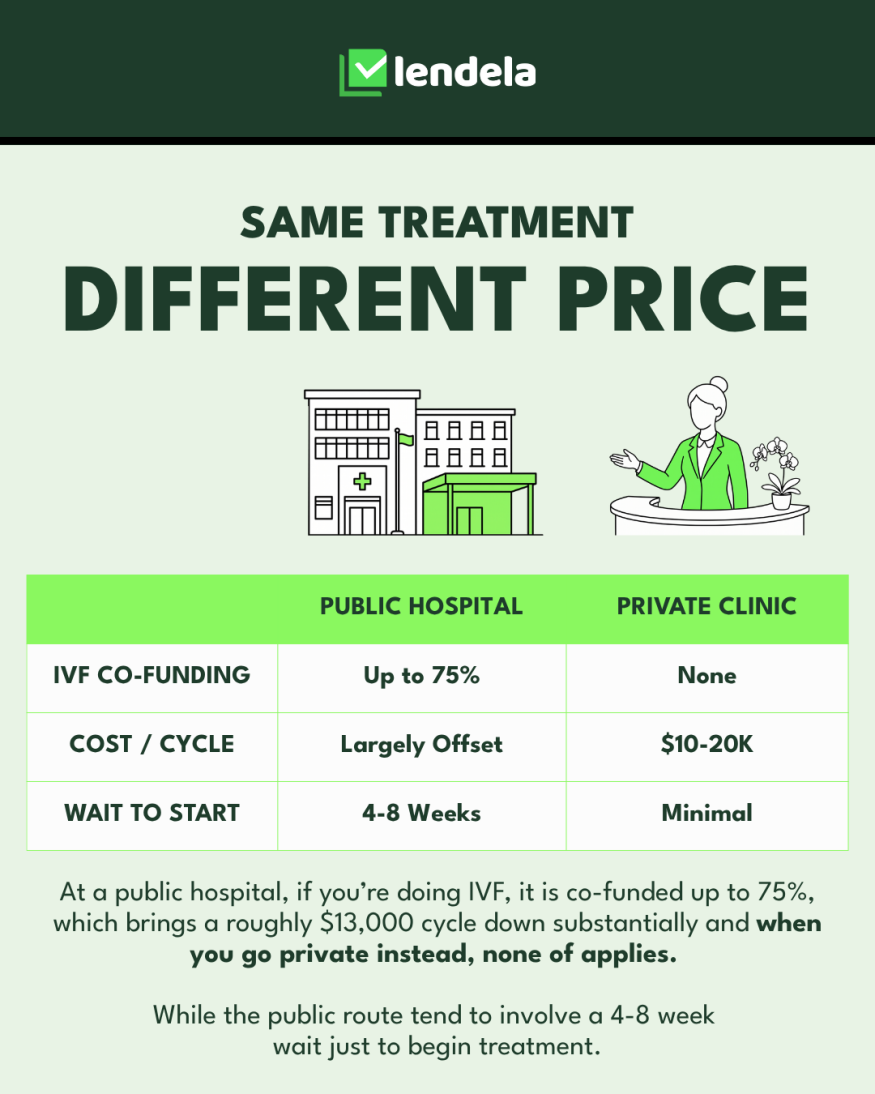
It depends almost entirely on where you go, and the difference is not small.
A fresh IVF or ICSI cycle costs roughly $13,000 before any subsidy. At a public hospital (NUH, SGH or KKH), the government co-funds a real share of that, tiered by citizenship:
Procedure | SC-SC couple | SC-PR couple | SC-Foreigner couple |
|---|---|---|---|
Fresh ART cycle | 75%, up to $7,700 | 55%, up to $5,700 | 35%, up to $3,600 |
Frozen ART cycle | 75%, up to $2,200 | 55%, up to $1,600 | 35%, up to $1,000 |
IUI | 75%, up to $1,000 | 55%, up to $700 | 35%, up to $500 |
On top of the co-funding, MediSave can be withdrawn: $6,000 for the first cycle, $5,000 for the second, $4,000 for the third and subsequent, up to a $15,000 lifetime cap per patient. Public treatment covers up to 3 fresh and 3 frozen cycles, extendable for women 40 and above who started treatment before turning 40.
Private fertility clinics receive zero government co-funding. A cycle runs $10,000 to $20,000 or more, entirely out of pocket beyond the same MediSave withdrawal limits above. What private buys instead is speed: public hospitals currently carry a 4 to 8 week wait just to begin treatment, which matters enormously given how directly age affects fertility outcomes month to month.
Neither option is wrong. It's a genuine trade-off between cost and time, and it's worth knowing both sides of it before choosing.
Why is my hospital bill so much higher than the advertised price?
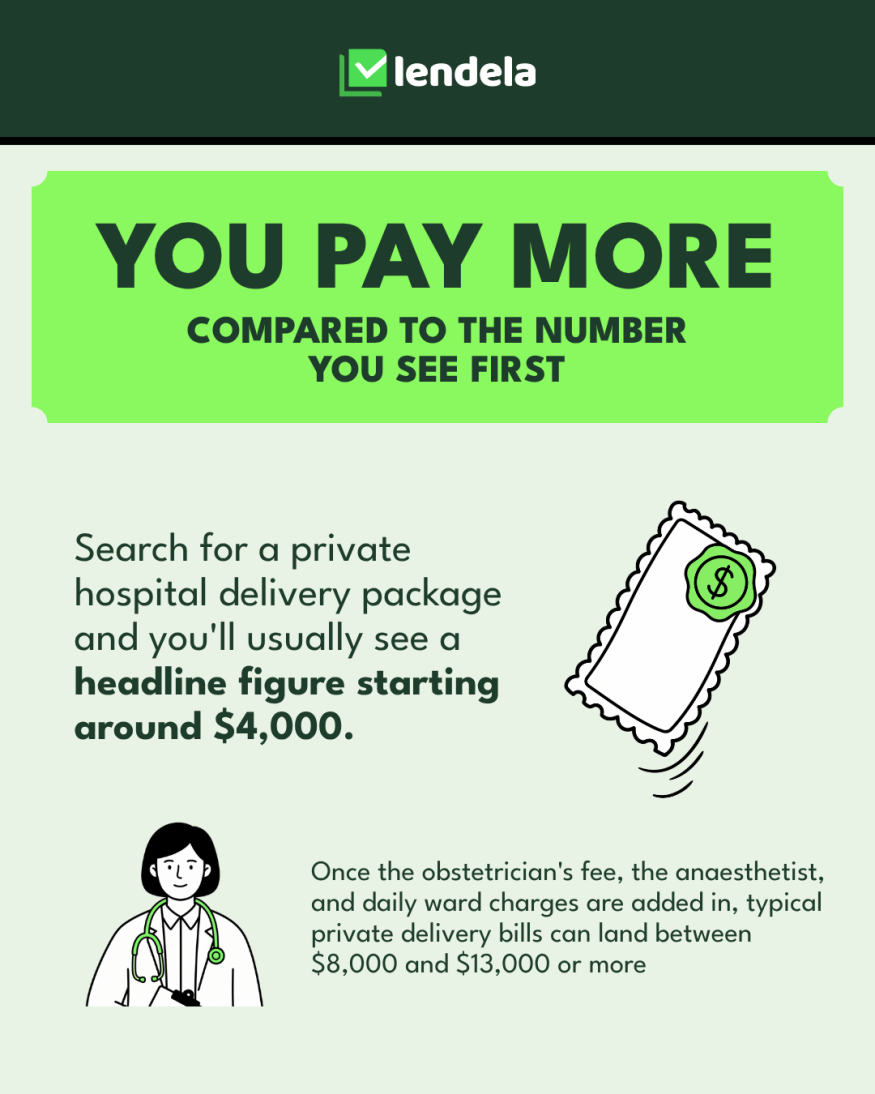
Because the advertised figure and the actual bill are usually describing two different things.
Search for a private hospital delivery package and the headline figure typically starts around $4,000. That number is real, it's just rarely what ends up on the bill. Once the obstetrician's fee, the anaesthetist, and daily ward charges are added, typical private delivery bills for the same room type run $8,000 to $13,000 or more, sometimes considerably more.
The clearest example of this gap: one hospital advertises its delivery packages from $4,188. According to the government's own published typical billing data, that same hospital's actual typical bill, for a 1-bed room and a vaginal delivery, is $13,367. A difference of over $9,000 between the number in the advertisement and the number on the invoice.
The full picture across hospital tiers, using the same government billing data:
Tier | Hospital | Typical actual bill, 1-bed, vaginal delivery |
|---|---|---|
Public, subsidised | KKH / NUH / SGH, Ward C (up to 80% subsidy) | $946 to $1,486 |
Private, mid-tier | Raffles / Parkway East / Mount Alvernia / Thomson | $8,417 to $10,802 |
Private, premium | Mount Elizabeth / Novena / Gleneagles | $12,597 to $13,367 |
A C-section adds roughly 50 to 100% to any of these figures, mainly from a longer hospital stay and higher surgical fees.
None of this means the advertised packages are dishonest, exactly. It means the advertised figure is usually the floor, not the average, and the obstetrician's fee, which is billed separately in most cases, is where the real cost tends to sit.
What does antenatal care cost before delivery day?
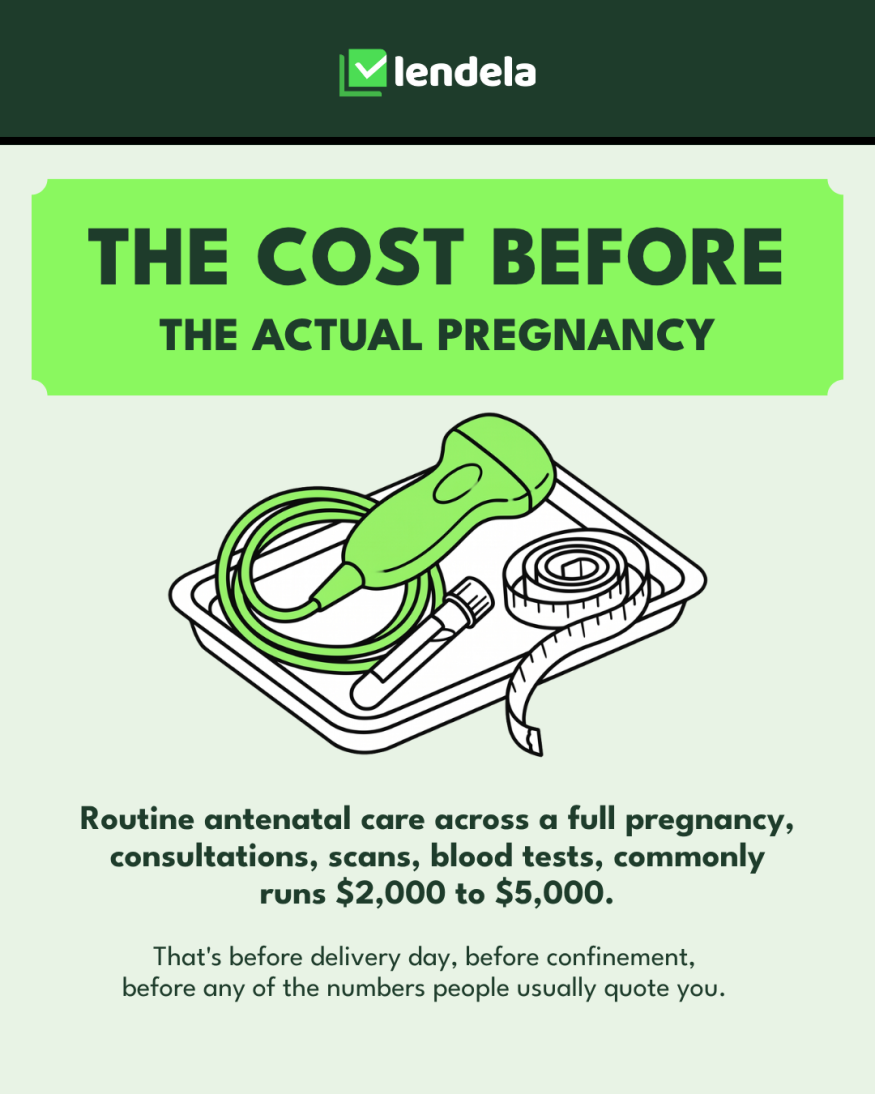
More than most people budget for, largely because it's spread across many small visits rather than one large bill.
Routine antenatal care across a full pregnancy, consultations, ultrasound scans, and blood tests, commonly runs $2,000 to $5,000 in total. That's before delivery day, before confinement, before any of the numbers people usually get warned about.
The government does help here too. The MediSave Maternity Package includes a $900 allowance for pre-delivery medical expenses, on top of what it covers for the delivery admission itself:
$1,130 per day for the first two days of hospital admission
$400 per day from day three onward
$1,120 to $2,770, depending on delivery type (vaginal or surgical)
Usable at both public and private hospitals, and drawable from either parent's MediSave account
Worth planning for separately from the delivery bill itself: some prospective parents also spend on prenatal fitness in the lead-up, with one-to-one prenatal personal training running $130 to $160 a session, or prenatal reformer Pilates at $104 to $160 a single session.
How much does a confinement nanny cost, and why isn't it covered?
A confinement nanny for the standard 28-day period typically costs $3,800 to $4,500, with a wider published range of $2,300 to $5,500 depending on the agency and the nanny's experience. On top of that: the Work Permit levy ($60 a month for a Singapore Citizen child, $300 if not), nanny insurance (roughly $250), and the customary ang bao given on the first and last days. If recovery runs past 28 days, common after a C-section, extension days typically cost $130 to $180 each.
Confinement centres, the newer "confinement hotel" model, cost roughly double a nanny package for a standard stay, and 5 to 10x for a luxury one, with some running past $20,000. A cheaper alternative some families use instead is confinement meal delivery alone, at $25 to $45 per meal, or $1,500 to $3,000 for a full month's package.
Worth planning around, not just budgeting for: MOM caps a confinement nanny's work permit at 16 weeks from the child's date of birth. Parents cannot apply for a confinement nanny permit at all once their newborn is older than 4 months, so this isn't a decision that can be deferred indefinitely, unlike a confinement centre or meal delivery booking, which have more flexible timing.
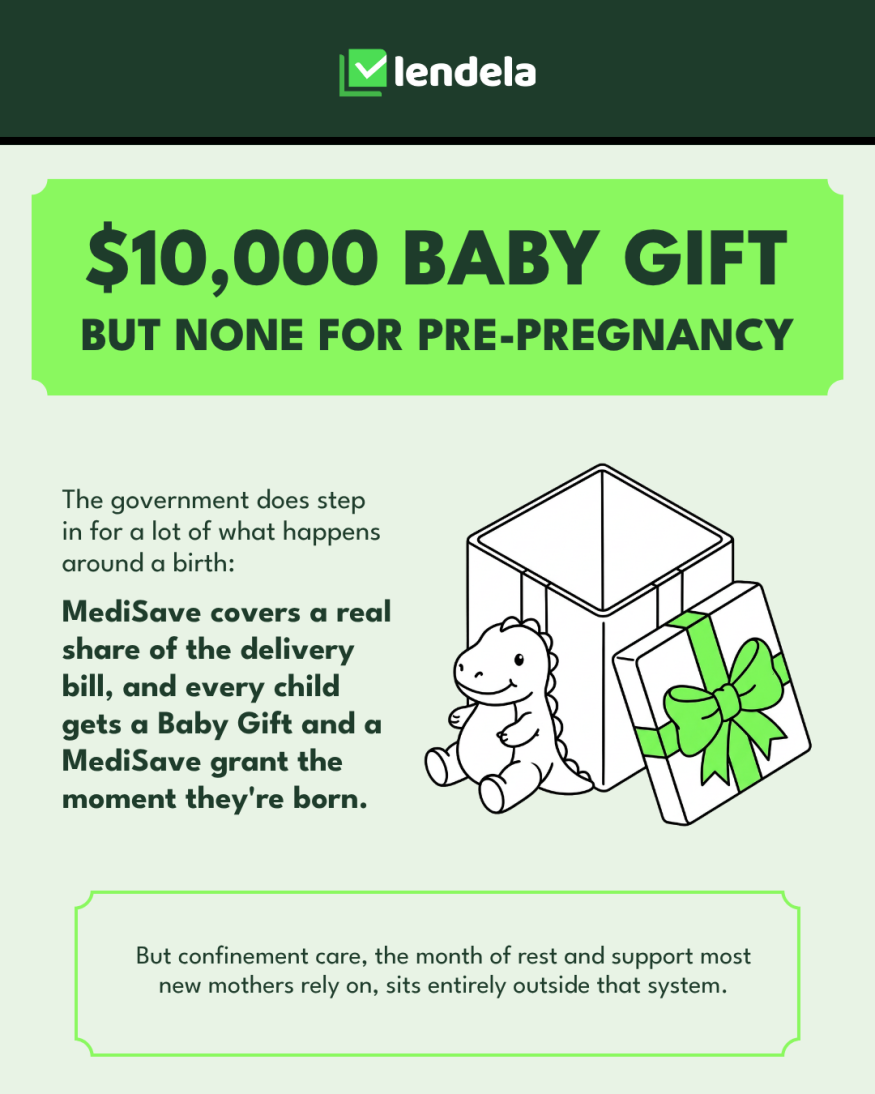
Here's the part worth genuinely knowing before the month arrives: the government does step in for a lot of what happens around a birth. MediSave covers a real share of the delivery bill. Every eligible child receives a Baby Gift and a MediSave grant the moment they're born. But confinement care, the very thing most new mothers rely on immediately afterward, sits entirely outside that system. It isn't CDA-eligible, since confinement nannies and centres aren't Baby Bonus Approved Institutions. It isn't MediSave-claimable. No scheme in the current or newly announced support package touches it, at any income level.
A family can receive the full Baby Gift and still pay $3,800 or more out of pocket for confinement care in that same month, with nothing anywhere in the system to offset it. This isn't a criticism of the support that does exist, most of which is genuinely substantial. It's simply the one real gap worth knowing about while there's still time to budget around it.
So what's the real range for everything before the baby comes home?

Put together, a family choosing the most subsidised path at every stage, public fertility treatment, a public hospital delivery, and a lower-cost confinement option, can keep this whole period to a few thousand dollars. A family choosing private care throughout, private fertility treatment, a premium private hospital, and a full confinement nanny package, can reasonably spend $25,000 to $35,000 or more before the baby's first night at home.
Neither path is right or wrong. What matters is knowing which choices actually move the number, and which costs, like confinement, exist entirely outside whatever support you're counting on.
The same kind of exercise works across almost anything worth budgeting for in Singapore. We've added up what living well here costs across a decade, in the same sourced, dated way.
Frequently asked questions
How much does IVF cost in Singapore? A fresh cycle costs roughly $13,000 before subsidy. At a public hospital, government co-funding covers up to 75% for Singapore Citizen couples (55% for SC-PR couples, 35% for SC-Foreigner couples), plus MediSave withdrawal of up to $6,000 for the first cycle. Private clinics receive no government co-funding at all, and cost $10,000 to $20,000 per cycle out of pocket.
Why is my actual hospital bill so much higher than the advertised delivery package? Advertised packages typically show a starting figure that excludes the obstetrician's fee, which is usually billed separately and makes up most of the difference. One hospital advertises packages from $4,188 while its typical actual bill, per government billing data, is $13,367 for the same room type and delivery.
How much does antenatal care cost in Singapore? Routine consultations, scans and blood tests across a full pregnancy commonly total $2,000 to $5,000, separate from the delivery bill itself. The MediSave Maternity Package includes a $900 allowance specifically for pre-delivery medical expenses.
Does a C-section cost more than a vaginal delivery? Yes, typically 50 to 100% more than the equivalent vaginal delivery bill at the same hospital, mainly due to a longer hospital stay and higher surgical fees.
How much does a confinement nanny cost in Singapore? A standard 28-day package typically costs $3,800 to $4,500, within a wider range of $2,300 to $5,500. Additional costs include the Work Permit levy, nanny insurance, and extension days if recovery runs longer, common after a C-section.
Is confinement care covered by any government scheme? No. Confinement nannies and confinement centres are not CDA-eligible, not MediSave-claimable, and not covered by any current or newly announced government support scheme, regardless of household income.
Is there a deadline to hire a confinement nanny? Yes. MOM caps a confinement nanny's work permit at 16 weeks from the child's date of birth, and parents cannot apply for a confinement nanny permit at all once their newborn is older than 4 months. Confinement centres and meal delivery services don't carry the same hard cut-off.
Sources
MOH, Marriage and Parenthood Schemes (ART co-funding table, MediSave withdrawal limits, MediSave Maternity Package figures)
MOH, Monthly Updates on Hospital Bill Sizes, and government typical hospital bill data by tier and delivery type
Gleneagles Hospital, official maternity package pricing, effective 3 August 2026
MissLobang, "8 Best Maternity Packages in Singapore 2026," cross-referencing MOH typical bill data against every major private hospital's advertised package
ECDA, overview of Baby Bonus Approved Institutions and CDA-eligible expenses
NewBubs, "Confinement Nanny Price Singapore 2026" and "Hidden Costs of a Confinement Nanny in Singapore"
Beauty Mums & Babies, confinement nanny and confinement centre guides, 2026
PEM Confinement and Confinement Angels, published 2026 agency rate cards
Prenatal fitness pricing, Donna O'Shea Fitness and LEVEL Singapore published rates
Figures verified as at September 2026, drawn from MOH's published schemes and billing data, government hospital bill statistics, and multiple current confinement agency rate cards. Actual costs depend on your specific hospital, doctor, room availability, delivery complexity, and personal circumstances, and can change without notice. Please treat every figure on this page as a guide rather than a quote, and confirm directly with the relevant hospital, clinic or agency before making any financial decision.
The Lendela Team
Lendela is a loan-matching platform that partners with 70+ MAS-licensed lenders. We aim to deliver a transparent, safe, and personalised loan-matching experience, empowering borrowers with confidence to choose what truly fits. Since launching in 2018, we’ve helped hundreds of thousands of Singaporeans make smarter, more informed financial decisions through clarity and control.