
The Lendela Team
December 8th, 2026
Table of contents
- A chase card's real price has three parts: what buyers pay now, what you could sell it for, and the cost of the hunt.
- A booster bundle with a $38.40 suggested retail price sold for $125 to $145 at a May 2026 Singapore card show, about 226% to 278% above retail.
- Two Ascended Heroes chase cards were about 18% and 31% lower on TCGplayer on 24 November than on 25 to 27 October, at US$504.62 and US$505.77.
- TCGplayer's report says one buyer picked up 18 copies of a One Piece promo card on 23 March 2026, the price more than doubled within a month, and the same copies were worth about US$25,500 by 14 July.
- Police logged at least 477 pre-order scam cases and at least $958,000 in losses from October 2025. They advise paying only after you receive and inspect the cards.
A chase card is the rare card in a new set that collectors hope to pull from a pack, and its real price is never the sticker. It is three numbers: what a buyer pays today, what you could get if you sold it tomorrow, and what the hunt costs along the way. In Singapore in 2026, those numbers sat far apart.
A Pokémon booster bundle with a $38.40 suggested retail price sold for $125 to $145 at a May card show, about 226% to 278% above retail. Two chase cards from the same set, Pikachu ex and Mega Gengar ex, were about 18% and 31% lower on TCGplayer on 24 November than they were a month earlier, at US$504.62 and US$505.77. One buyer picked up 18 copies of a single One Piece promo card in a day, copies that cost roughly US$6,840 in March and were worth about US$25,500 by mid-July. And police logged at least 477 pre-order scam cases from October 2025, with at least $958,000 lost.
Nostalgia is a good reason to collect. The chase is a different thing, and the two get confused. This guide covers what the cards cost, why prices rise and fall, how a few buyers can move a price, and how to tell collecting from speculating. All $ figures are Singapore dollars, and US$ figures are US dollars.
What is a chase card, and why do people chase it?
Ask a collector which card they wanted at school, and the answer comes back fast. Pokémon began in Japan in 1996 as a Game Boy video game, and the trading card game followed the same year with a 102-card Base Set that children swapped in playgrounds around the world, according to the Straits Times.
A chase card is the card that makes a new set exciting: the rare, beautifully illustrated one that few packs contain. In the Ascended Heroes set, released in January 2026, TCGplayer lists Pikachu ex 276/217 among the top chase cards. It is a Special Illustration Rare that fans nicknamed "Treekachu" for its sunlit forest scene.
The hobby went from playground to price tag in a few steps. Locked-down adults rediscovered their childhood cards during the pandemic, at the same time as grading services, live-streamed pack openings and social media made rare finds more visible, the Straits Times reports. In February 2026, a Pikachu Illustrator card sold at auction for US$16.5 million, more than the roughly US$12 million a Monet painting fetched at Sotheby's in April.
NUS finance professor Sumit Agarwal describes the shift this way: once graded cards, limited print runs and condition rankings make scarcity verifiable, pricing becomes easier and speculation follows. That is the line between loving a card and pricing it.
What does a booster bundle really cost?
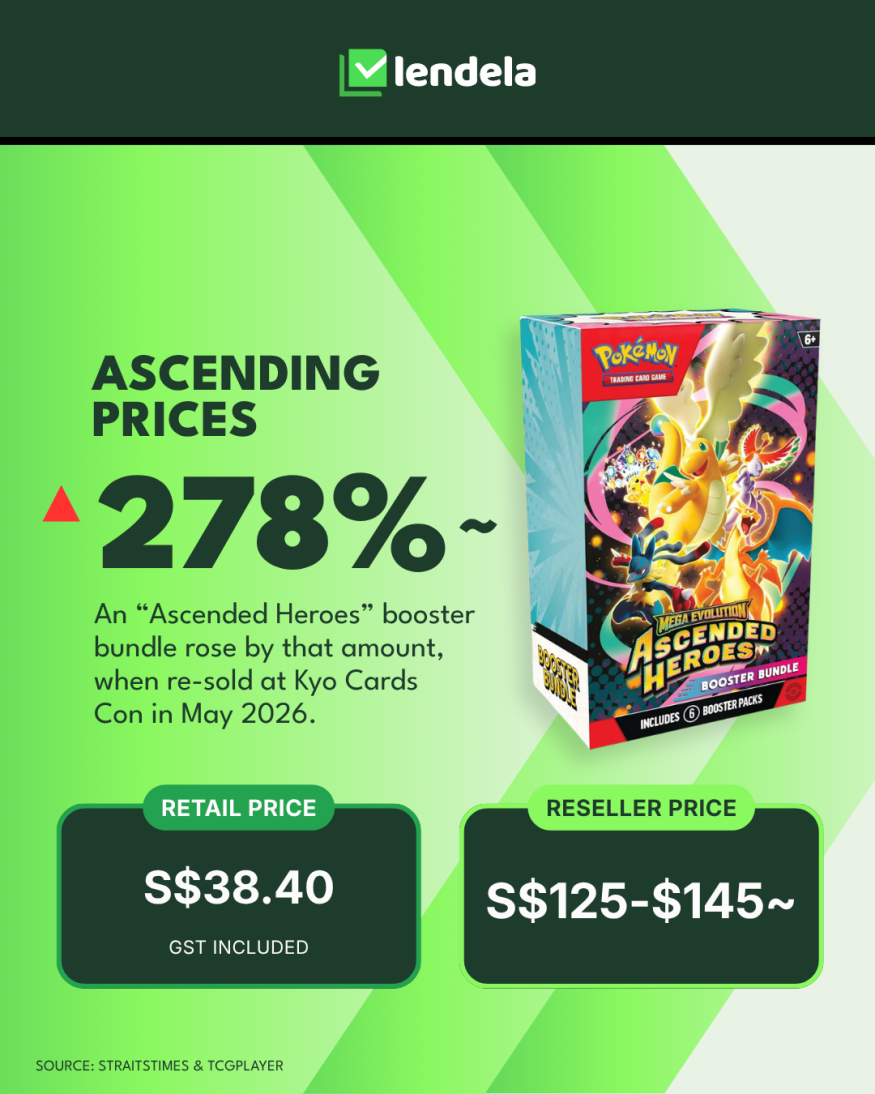
Kyo Cards Con, held at Singapore Expo on 2 and 3 May 2026, drew about 10,000 visitors, and more than $300,000 in deals changed hands in the first four hours of the first day, the Straits Times reports.
Sealed packs are sold at suggested retail prices at FairPrice, Don Don Donki, Toys "R" Us and the Pokémon Center online store, but they sell out quickly. The shortage created an opening for vendors, who resold packs at steep mark-ups.
Where | Price | Amount of Change |
|---|---|---|
Suggested retail price | $38.40 | Starting point |
At the show, low end | $125 | ↗226%~ |
At the show, high end | $145 | ↗278%~ |
An Ascended Heroes booster bundle of six packs breakdown in prices from the Straits Times figures.
That gap is the first of the three prices: the one set by scarcity on the day. Someone paid it because the shelves were empty, not because the cards inside had changed.
Why do chase-card prices rise, then fall?
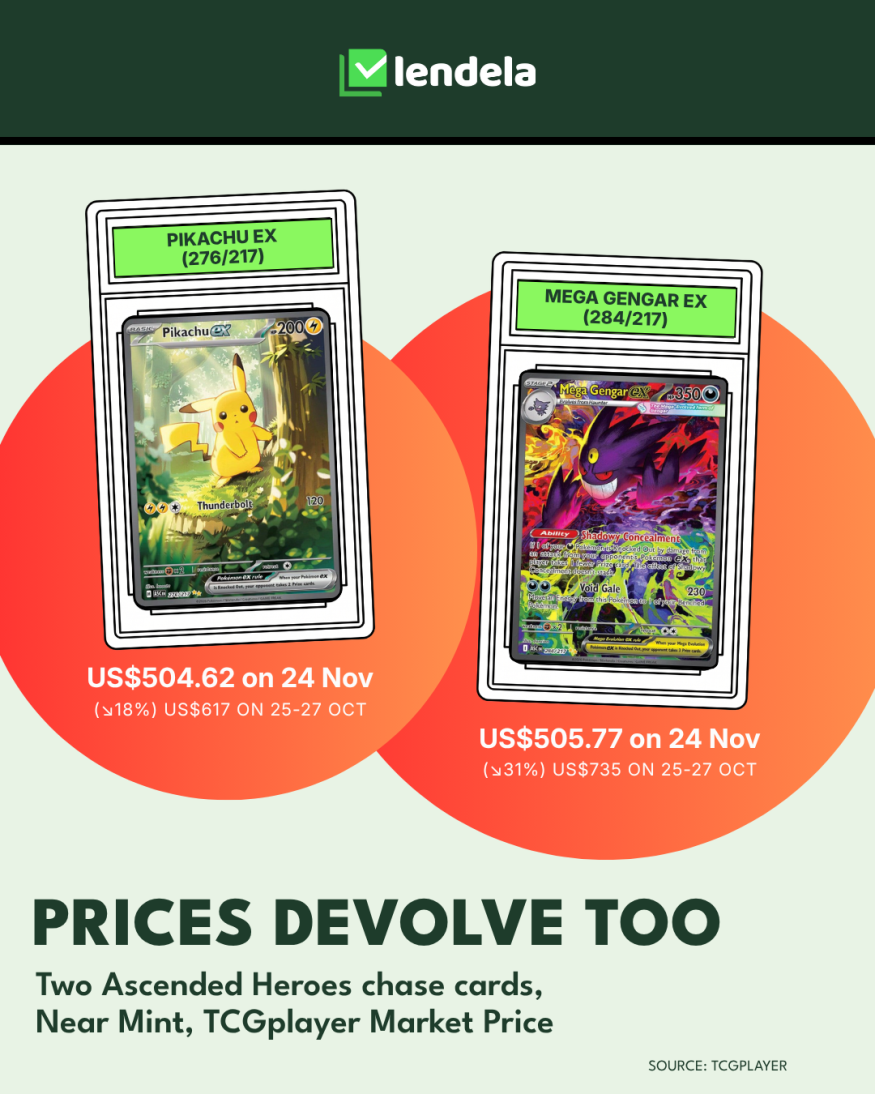
Prices do not run one way. TCGplayer's report of 13 October 2026 says that around July, after months of wild price appreciation, modern Pokémon singles began to retrace as waves of reprints caught up with demand. Ascended Heroes fell furthest. The report says the staggered release of the set through the year slowly eroded the value of its two four-figure chase cards, Pikachu ex and Mega Gengar ex, and of the set's other hits with them.
Mega Dragonite ex shows the shape. TCGplayer's report describes its price as US$500 at the start of February, US$875 in June and US$506.15 on 13 October, according to the report's table.
Before the prices, a note on what they measure:
TCGplayer's figures are for raw, ungraded cards, which sellers rate on a five-step condition scale: Near Mint, Lightly Played, Moderately Played, Heavily Played and Damaged. "Holofoil" describes the shiny foil finish of the card, not its condition, so "Near Mint Holofoil" means a foil card in near-new condition, as a seller rates it.
A PSA graded card is different: a company such as PSA inspects it, gives it a score from 1 to 10, and seals it in a slab.
PSA grade | Name | What it means |
|---|---|---|
10 | Gem Mint | Virtually perfect |
9 | Mint | Superb, with one minor flaw |
8 | Near Mint-Mint | Looks Mint at first glance, with slight corner fraying |
7 | Near Mint | Slight surface wear on close inspection |
6 | Excellent-Mint | Visible surface wear or a print defect |
5 and below | Excellent down to Poor | Increasing wear, rounded corners and creases |
PSA's definitions are paraphrased. TCGplayer's condition scale and PSA's scale are separate, and there is no official match between them.
PSA's 7 is called Near Mint, so the two scales are often compared. A raw Near Mint card is only a candidate for a high grade, not a promise of one, which is why graded and raw prices for the same card are quoted separately.
We checked two chase cards on TCGplayer's own pages on 24 November.
Card | 25 to 27 Oct (chart) | 24 Nov market price | Change | Lowest listing |
|---|---|---|---|---|
Pikachu ex (276/217) | US$617~ | US$504.62 | about ↘18% lower | US$575.99 |
Mega Gengar ex (284/217) | US$735~ | US$505.77 | about ↘31% lower | US$531.06 |
Near Mint Holofoil, TCGplayer Market Price. The October values are read from TCGplayer's price chart, so treat the change as approximate.
The pages show a second number worth noticing. The most recent sales were US$263.00 for Pikachu ex and US$342.00 for Mega Gengar ex, both below the market price. Market price and sale price are not the same thing, which is the second of the three prices: what you could get if you sold.
NTU assistant professor Chua Yeow Hwee puts the underlying reason plainly: "Their prices depend heavily on beliefs and community attention." That does not make the cards worthless, he adds, but it makes their value socially produced, not tied to cash flows like stocks or bonds.
Can one buyer move a price?
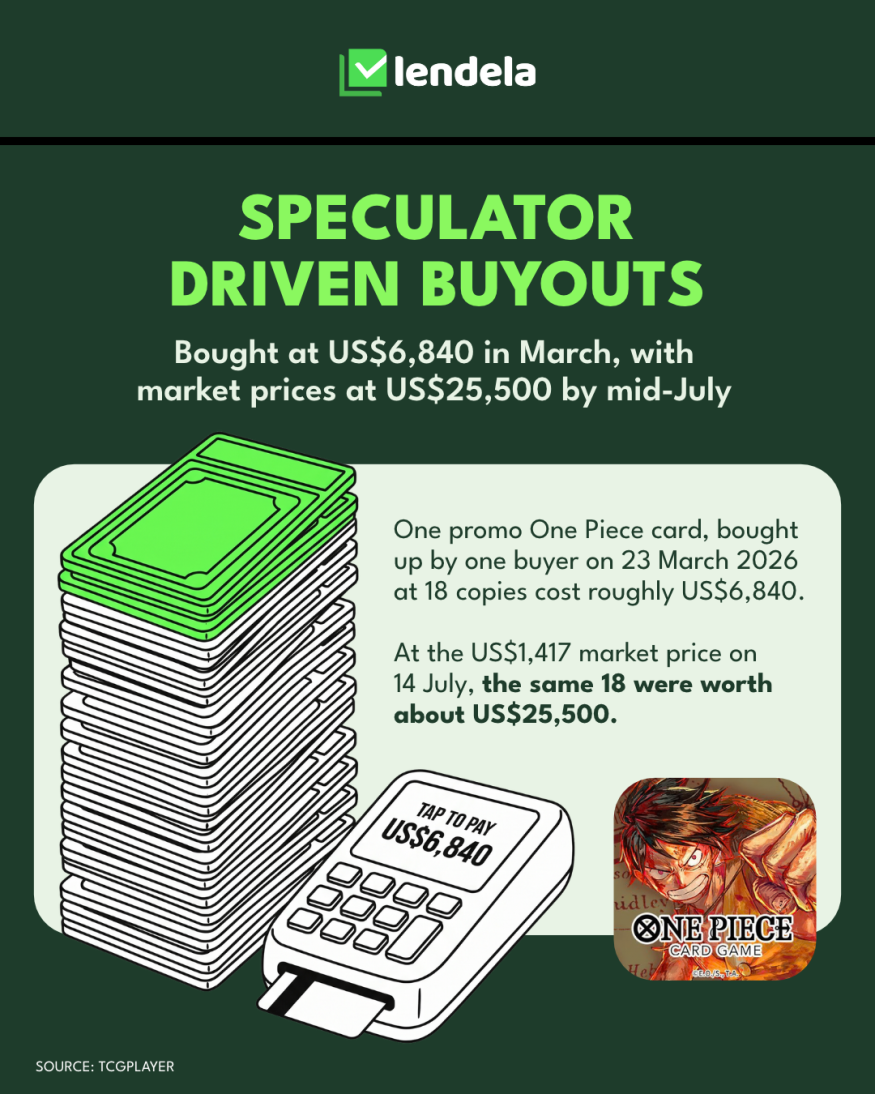
On 23 March 2026, one buyer picked up 18 copies of a single One Piece promo card, the English-version 1st Anniversary Set Monkey.D.Luffy, in one go, according to TCGplayer's price report of 14 July. The card had been stable at about US$380 in early 2026.
Smaller buyouts followed on 10 April and 19 May, the report says, which wiped out the remaining supply and sent the price more than doubling in a single month. By 14 July its market price was US$1,417.07.
When | Price per copy | 18 copies |
|---|---|---|
Early 2026 | about US$380 | about US$6,840 |
14 July 2026 | US$1,417.07 | about US$25,500 |
It was not the only case in that report. A Judge Pack promo Luffy sat at or below US$1 for months before buyouts began in October 2025. One individual then bought 28 copies on 3 April and 37 on 13 April, and the card stood at US$98.48 on 14 July. Another promo Luffy, stable under US$20 in November 2025, was sent to US$70 by a run of buyouts and had slid back to US$35 by March, a pattern TCGplayer says may repeat.
TCGplayer says the most dramatic spikes in obscure promo cards appear to be driven largely or entirely by speculator-driven buyouts, which is its reading of its own sales data. For anyone buying, the point is plain: a price built on a few buyers can unwind as quickly as it formed, and 18 copies add up when a single card is worth four figures.
What happens when a pre-order never arrives?
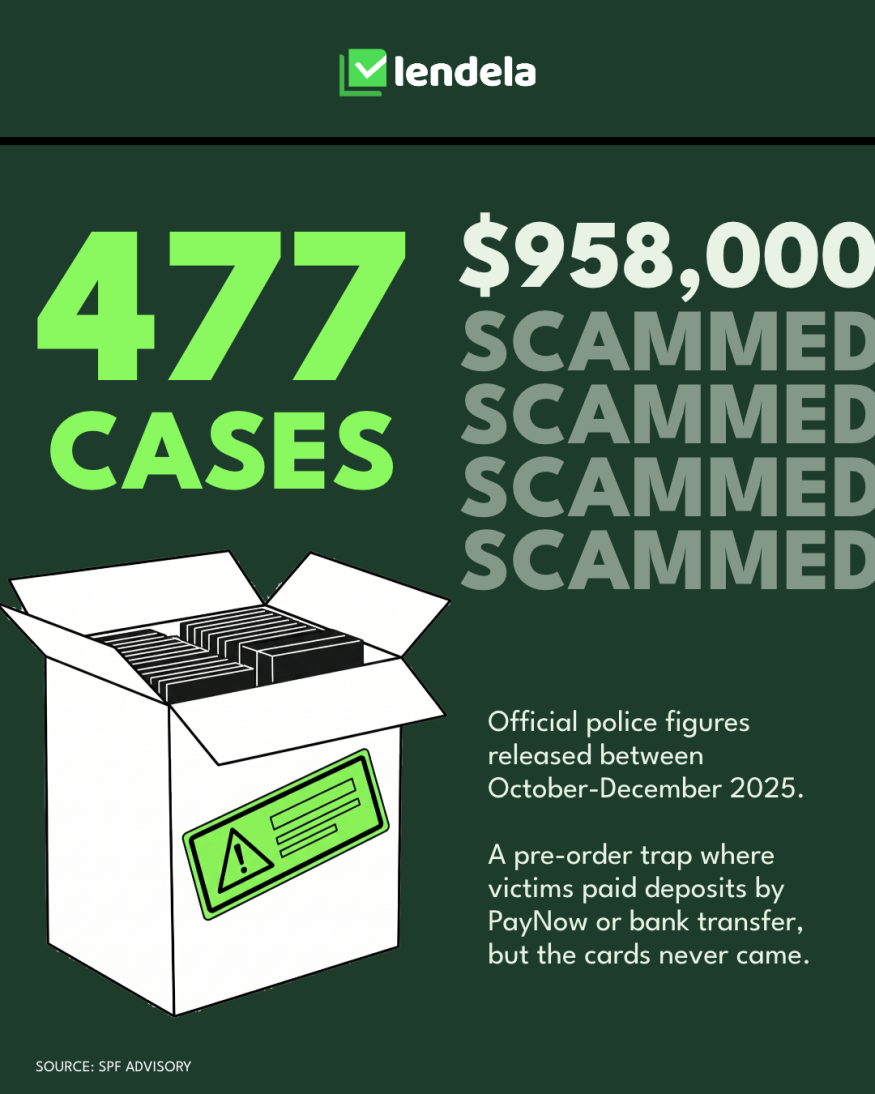
The same hype that lifts prices lets scammers promise a sold-out set. In December 2025, the Singapore Police Force warned that at least 477 e-commerce scam cases involving Pokémon cards had been reported since October, with total losses of at least $958,000.
The scam followed one pattern. Victims found pre-order listings on platforms such as Carousell, were persuaded to pay an initial deposit by PayNow or bank transfer, and only realised when the cards never arrived or the seller became uncontactable.
Two weeks earlier, police had arrested a 29-year-old man for suspected involvement in a series of pre-order cases. According to the police release, he was linked to at least 111 cases and losses of more than $80,000.
The advice from Singapore Police Force is specific:
Buy only from authorised sellers, on online platforms and in physical stores.
Use secure payment methods such as cash on delivery, so you can inspect the cards before you pay.
Do not pay anything before you receive or inspect the products.
Be wary of large discounts offered for faster transactions.
Call the ScamShield helpline on 1799 if you are unsure, and report suspicious listings in the platform's app. If you have paid, call your bank at once and make a police report.
What is the difference between collecting and speculating?
The Straits Times found both sides at the same card show. One collector, who gave only the name James, sold a mint-condition 2002 Japanese holo Gengar for $17,500, having acquired it four months earlier for less than $9,000 in cash terms. He told the paper there are cards he will never sell and others he will let go at the right price. Another, Mr Lee, bought a Snap Pikachu card for $11,000 in March and sold it to a Hong Kong buyer for US$65,000 less than two months later. He said prices were extremely high and that the gains existed on paper.
The same feature adds the other side. Not every card follows those headline trajectories, and valuations passed around on social media and convention floors often rest on the highest recent sale or an ambitious asking price, not on what a card reliably fetches.
Collectors who buy near a peak can end up holding a slab, a professionally graded card sealed in a hard, tamper-evident case, that looks valuable on paper and draws little interest when it is time to sell. Our two chase cards fit that picture: on 24 November, their latest sales sat below their market prices.
There is nothing wrong with feeling something when you see a card you owned at school. That feeling is where the hobby started, and it is a reason to collect.
The trouble starts when the reason you love a card and the reason you might sell it get welded together: hold them apart, and each gets an honest answer.
Question | If the answer is | Then |
|---|---|---|
Is the price a recent sale, or an asking price? | An asking price | Check sold prices first, such as TCGplayer's most recent sale and three-month range |
Are you being asked to pay before you receive the cards? | Yes | Do not pay. Use cash on delivery or an authorised seller |
Are you buying because you love it, or because it might go up? | Because it might go up | Treat it as speculation, and use only money you can afford to lose |
PS. This is not financial advice or a recommendation to buy or sell cards.
How do you collect without chasing the hype?
Pick the card you actually love, and decide what it is worth to you in dollars before you open a listing.
Compare sold prices, not asking prices, and note how many copies sold.
Check a sudden jump on a promo card that sees little play, since it may reflect a few buyers.
Buy from authorised sellers, and pay only after you inspect.
If paying would mean borrowing or a pay-later plan, remember that the total repayment is part of the card's price.
What was the card that started it?
Somewhere there is a card that began all of this for you: the one you traded for at school, or the one you never managed to get. That card's price was never the point. Keep that one, and let the market do what it does around it.
The same exercise works for other everyday costs. We have added up what subscriptions really cost and the real price of 11.11.
Frequently asked questions
What is a chase card?
A chase card is the rare card in a new set that collectors hope to pull from a pack. In the Ascended Heroes set, TCGplayer lists Pikachu ex 276/217, a Special Illustration Rare, among the top chase cards. Rarity and artwork drive the demand.
Are Pokémon card prices going up or down in 2026?
It depends on the card and the month. TCGplayer's reports show Ascended Heroes chase cards climbing from February to around June, then falling as supply grew. On 24 November, Pikachu ex and Mega Gengar ex were about 18% and 31% lower than on 25 to 27 October.
Why did a $38.40 booster bundle sell for $125 to $145?
The Straits Times reports that sealed packs sell at suggested retail prices in stores but often sell out almost at once. That shortage let vendors at a May 2026 card show resell the Ascended Heroes booster bundle at $125 to $145, about 226% to 278% above retail.
How do I avoid Pokémon card pre-order scams in Singapore?
Police advise buying only from authorised sellers, using secure payment such as cash on delivery, and paying nothing before you receive or inspect the cards. They also warn against large discounts offered for faster transactions. If you are unsure, call the ScamShield helpline on 1799.
What does a graded card, or slab, mean?
A slab is a professionally graded card locked inside a hard, tamper-evident plastic case, assessed and authenticated by a trading card grading company, according to the Straits Times. The grade and the case make condition easier to compare, which is why pricing becomes easier.
Is a Pokémon card a good investment?
We can't say, and this is not financial advice. NTU's Chua Yeow Hwee notes that card prices depend heavily on beliefs and community attention, not on cash flows like stocks or bonds, and our own two examples fell 18% and 31% in a month. Decide first whether you are collecting or speculating.
What is the difference between market price and sale price?
TCGplayer's Market Price is the marketplace's own measure for Near Mint copies, while a sale price is what one copy actually sold for. On 24 November, the most recent sale of Pikachu ex was US$263.00 against a market price of US$504.62.
What does Near Mint Holofoil mean on TCGplayer?
It is a foil card in near-new condition, as rated by the seller, and it is not graded. Holofoil is the shiny finish, and Near Mint is the top step of TCGplayer's five-step condition scale. A PSA grade is a separate score from 1 to 10 given by a grading company, and there is no official match between the two.
Sources
The Straits Times, Cash, cards and Charizards (27 May 2026)
Singapore Police Force, Police advisory on e-commerce scams (18 December 2025)
Singapore Police Force, Man arrested, Pokémon card cases (2 December 2025)
TCGplayer, Pokémon price report (13 October 2026)
TCGplayer, One Piece price report (14 July 2026)
Professional Sports Authenticator (PSA), grading standards for trading cards, psacard.com
TCGplayer, Pikachu ex 276/217 and Mega Gengar ex 284/217, product pages (24 November 2026)
Prices as at 24 November 2026 unless stated. Card prices change daily, and TCGplayer's Market Price is the marketplace's own measure, not a valuation. $ figures are Singapore dollars and US$ figures are US dollars.
This is general information, not financial advice or a recommendation to buy or sell cards, and your own situation will differ.
The Lendela Team
Lendela is a loan-matching platform that partners with 70+ banks and financial institutions. We aim to deliver a transparent, safe, and personalised loan-matching experience, empowering borrowers with confidence to choose what truly fits. Since launching in 2018, we’ve helped hundreds of thousands of Singaporeans make smarter, more informed financial decisions through clarity and control.