
The Lendela Team
September 10th, 2026
Table of contents
- Run clubs cost nothing to join, but a committed year past $2,000 once shoes, races, recovery and the coffee after are counted.
- The coffee is the biggest single line. Twenty dollars every Saturday is $1,040 a year, more than two pairs of shoes.
- Shoes last 500 to 800km. At 20km a week that is at least two pairs a year, and a Nimbus or Kayano is $259.
- Race fees are priced on timing, not distance. The same Singapore Marathon ran about $137 early bird and about $197 on race day.
- Weekly sport participation in Singapore rose from 54% to 76% between 2015 and 2025, and the free volunteer-led club is the format that drove it.
Joining a run club in Singapore costs nothing. Most clubs have no membership fee, no sign-up and no minimum commitment: you turn up at the meeting point, you run, you go home. A committed year of it, though, lands somewhere past $2,000.
That figure comes from four categories, none of which the club itself charges you for. Shoes are the obvious one, at $259 for a Nimbus or Kayano and around $429 for a race-day carbon plate, replaced roughly every 500 to 800km, which at 20km a week means at least two pairs a year. Race entries run from $25 for a small community race to about $197 for a race-day Singapore Marathon registration. Recovery is the quiet one, with physiotherapy at a private clinic around $207 a session and cold plunge single passes between $38 and $55.
And then there is the largest single line, which is not equipment at all. It is the coffee afterwards. Twenty dollars every Saturday is $1,040 a year, more than two pairs of shoes.
A casual runner doing 10km a week with one small race and coffee twice a month lands closer to $800. Someone chasing race times can pass $3,400. All figures below are retail prices as at August and September 2026, with sources named.
Why did run clubs take off in Singapore?
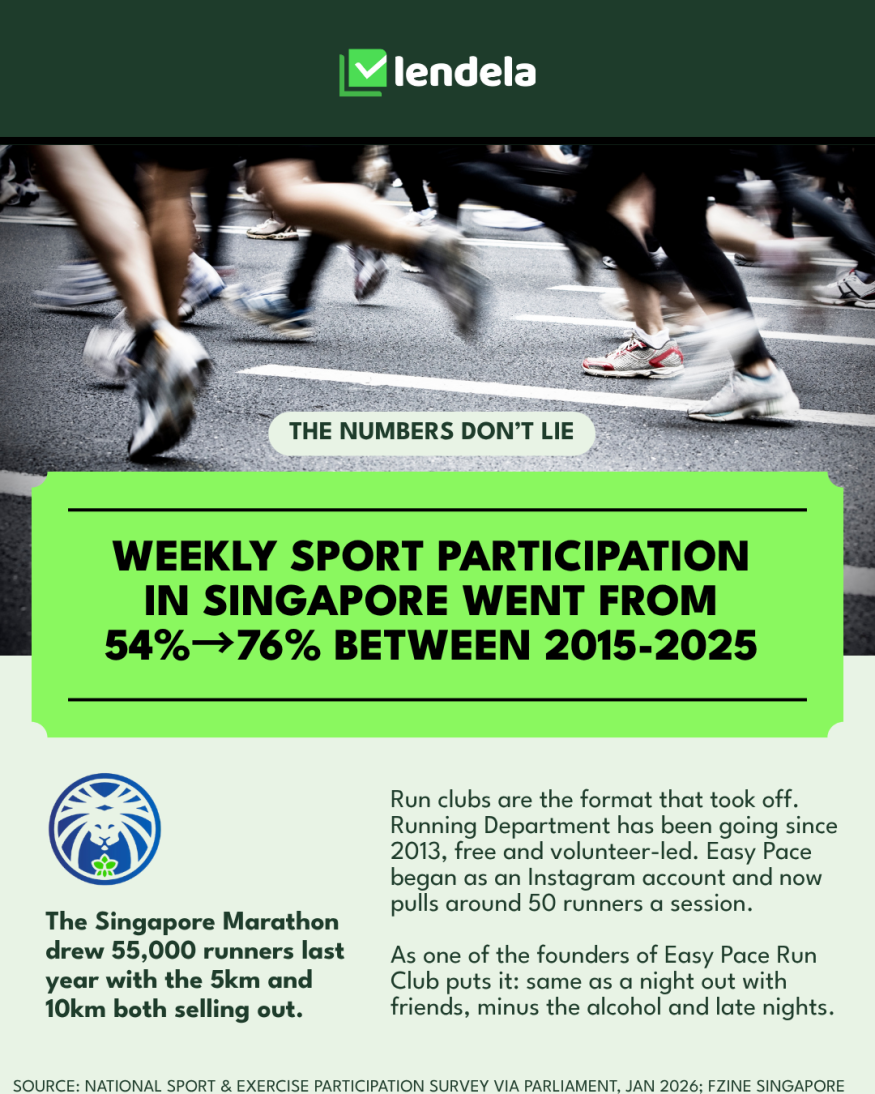
Weekly sport participation in Singapore rose from 54% to 76% between 2015 and 2025, according to the National Sport and Exercise Participation Survey cited in Parliament in January 2026. That is a twenty-two point move in a decade, which for a national behaviour statistic is enormous.
Running absorbed a lot of it. The Singapore Marathon drew 55,000 runners last year, with both the 5km and the 10km selling out.
But the format that actually did the work was not the race. It was the club.
Running Department has been going since 2013, free and volunteer-led, which at this point makes it older than most of the fitness apps people track their runs on. Easy Pace started as an Instagram account and now pulls around 50 runners to a session. Neither charges anything. Neither requires you to be fast, or to commit, or to tell anyone you are coming.
One of the founders of Easy Pace has described the appeal as being much like a night out with friends, without the alcohol or the late nights. That is a more precise description of the product than it first sounds. The run is the occasion. What people are actually turning up for is a standing weekly appointment with other people, in a city where those are surprisingly hard to maintain past your twenties.
Which is also, as it turns out, where most of the money goes.
How much do running shoes cost, and how often do you replace them?
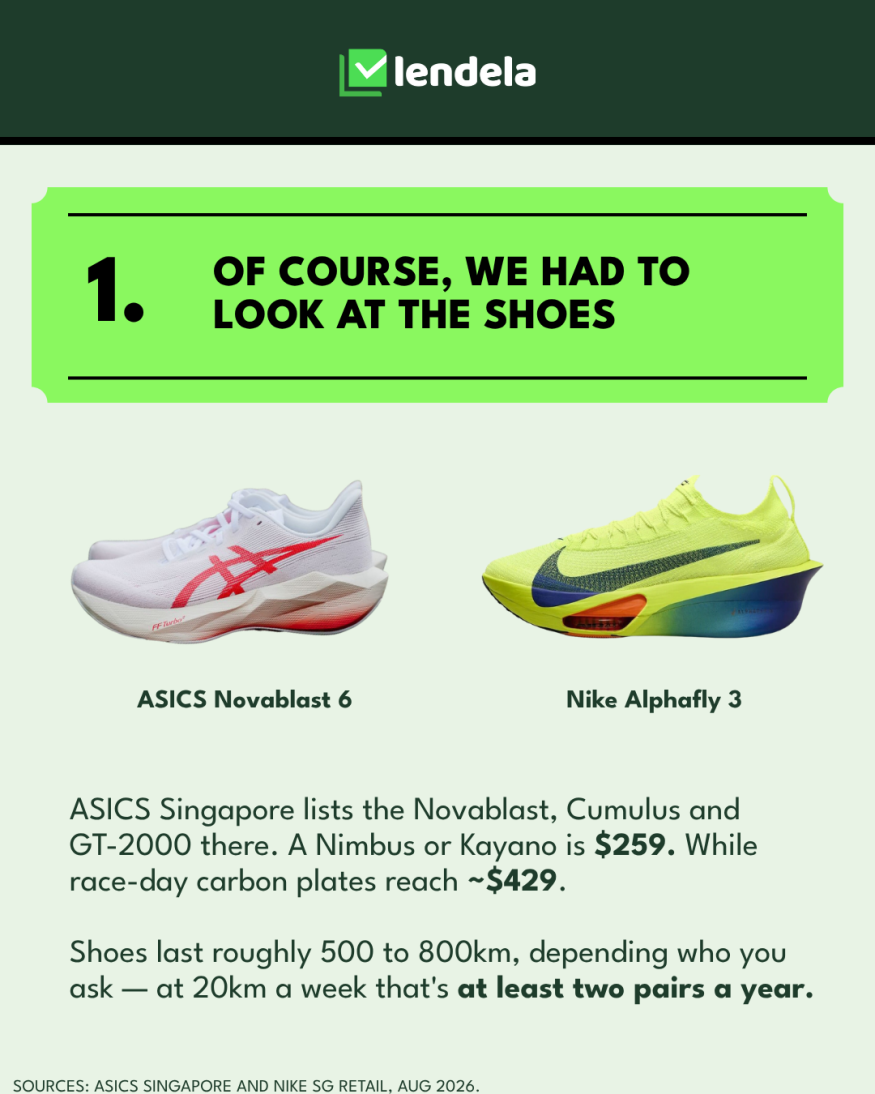
A Nimbus or a Kayano is $259 at ASICS Singapore retail as at August 2026. The Novablast, Cumulus and GT-2000 sit below that. A race-day carbon plate reaches around $429.
The number that actually matters is not the price though. It is the replacement cycle.
Running shoes last roughly 500 to 800km depending on who you ask, your weight, your gait and what you run on. At 20km a week, which is a very ordinary volume for someone in a club doing one weekend long run and a couple of weekday sessions, that is 1,040km a year. Against a 500 to 800km lifespan, that means at least two pairs, and possibly three.
So the honest annual figure for shoes is not $259. It is $518 and up, and that is before anyone mentions the second pair you keep for races, or the trail pair, or the fact that most runners end up rotating two pairs anyway because it extends the life of both.
This is the pattern that repeats through every category below. The sticker price is knowable and small. The recurring price is the one that adds up.
How much are race fees in Singapore?
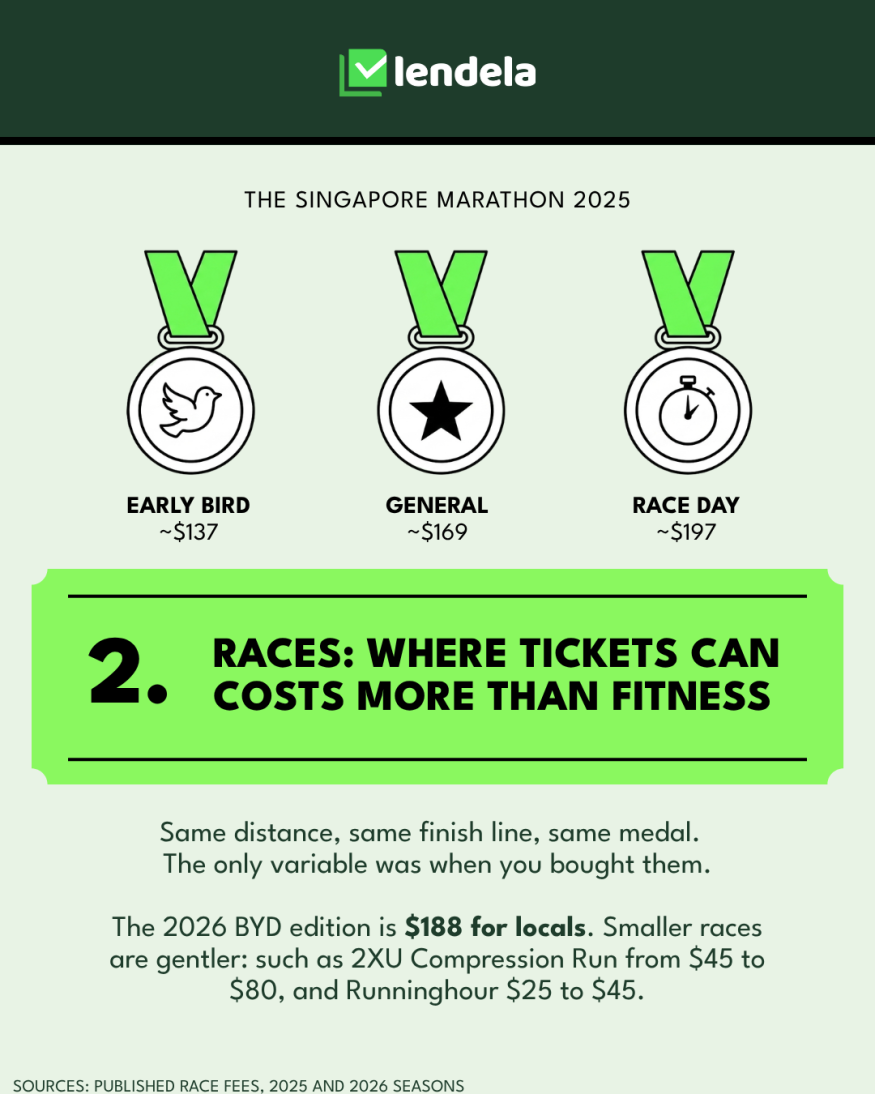
For the 2025 Singapore Marathon, published entry fees ran approximately:
Registration window | Fee |
|---|---|
Early bird | ~$137 |
General | ~$169 |
Race day | ~$197 |
Same distance, same finish line, same medal. The only variable was when you signed up.
That is worth pausing on, because it is a pricing structure most people accept without noticing. You are not paying more for more race. You are paying a $60 premium for having decided late, which is the same mechanism as an airline fare and rarely described as plainly.
The 2026 BYD edition is $188 for locals. Smaller races are considerably gentler: the 2XU Compression Run runs from $45 to $80, and Runninghour from $25 to $45.
For most club runners the realistic annual figure here is one or two events, so somewhere between $35 and $270 depending on whether a marathon is in the plan. It is the most controllable line in the whole budget, and the one where booking three months earlier saves the most.
What does recovery actually cost?
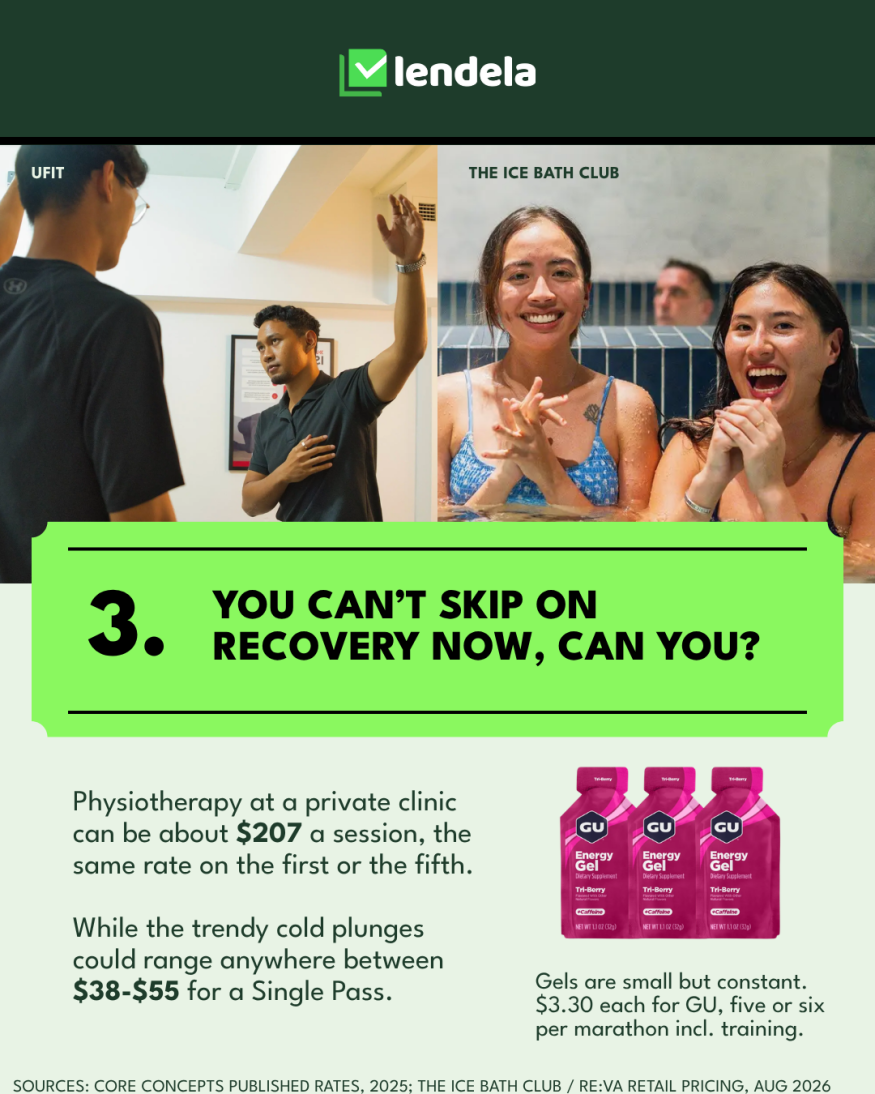
This is the category people do not budget for, because at the point of joining a free run club nobody is thinking about physiotherapy.
Physiotherapy at a private clinic can run around $207 a session, based on Core Concepts published rates in 2025. Worth knowing: it is generally the same rate on the fifth visit as the first, so an ongoing niggle does not get cheaper the longer you manage it.
Cold plunges have moved from novelty to routine for a certain kind of runner, and a single pass sits between $38 and $55 at operators including The Ice Bath Club and RE:VA, as at August 2026.
Gels are small and constant. GU energy gels are $3.30 each, and a marathon plus its training block will get through five or six.
Individually none of these register. Two physio sessions, a handful of plunges over a year and gels through one training block is over $600, which is more than the shoes and the races combined. It is the least visible spending in the sport and comfortably the second largest.
Why is the coffee after the run the biggest line item?
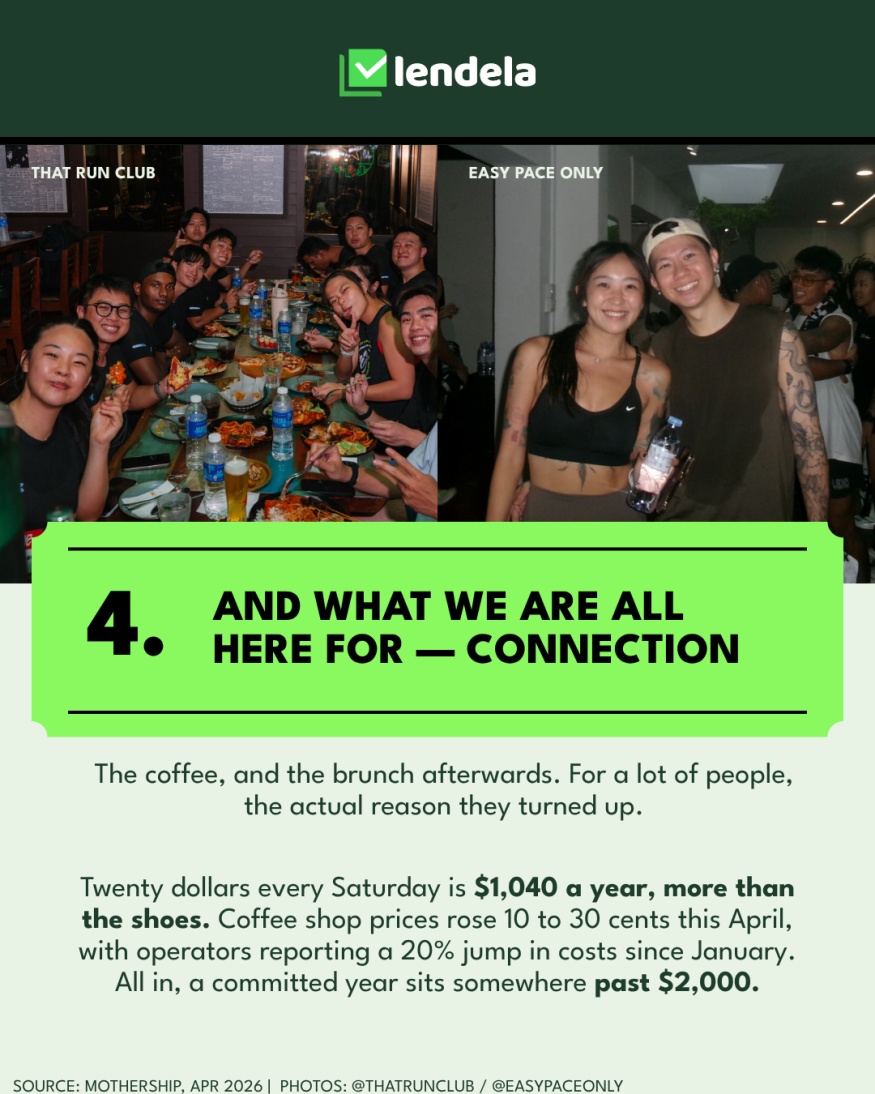
Twenty dollars every Saturday is $1,040 a year.
That is more than two pairs of shoes. It is more than a marathon entry and a season of smaller races put together. And it is the only line on this list that nobody thinks of as a running expense, because it does not feel like one. It feels like brunch.
Coffee itself has moved too. Coffee shop prices in Singapore rose 10 to 30 cents in April 2026, with operators reporting a roughly 20% jump in costs since January, according to Mothership.
Here is the thing worth saying plainly though, because the arithmetic could easily be read as an argument against it: the coffee is not the waste. For a great many people the coffee is the entire reason the habit survives past week three. The run is what you tell people you are going for. The table afterwards is what gets you out of bed at 6am in the rain.
A $1,040 annual cost for a weekly standing social appointment that also keeps you running is, by most measures, cheap. It is only surprising because nobody counts it.
So what does a year actually add up to?
Three illustrative scenarios, built from the verified unit prices above. These are worked examples rather than survey data, and your own year will sit somewhere between them.
Casual | Committed | Chasing times | |
|---|---|---|---|
Weekly distance | 10km | 20km | 40km+ |
Shoes | $259 (1 pair) | $518 (2 pairs) | $688 (1 pair + carbon) |
Races | $35 (1 small) | $264 (marathon + 2 small) | $510 (4 events) |
Recovery | ~$10 (gels only) | ~$614 (2 physio, plunges, gels) | ~$1,228 |
Coffee | $480 (fortnightly) | $1,040 (weekly) | $1,040 (weekly) |
Annual total | ~$784 | ~$2,436 | ~$3,466 |
The shape is the point. In every column the coffee and the recovery together outweigh the shoes and the races, which is the reverse of how anyone would guess it before adding it up.
Is it worth it?

For most people, obviously yes. Two thousand dollars a year for a habit that keeps you fit and gives you a standing weekly appointment with people you like is not an extravagance, and there is no version of this article that ends with a recommendation to run less.
The only useful thing to take from it is that the club being free does not make the habit free, and the costs that surprise people are never the ones on the shelf. They are the recurring ones: the second pair of shoes in October, the physio you booked because something in your knee started talking, the Saturday brunch that has quietly become a $1,040 line item.
And it is entirely fine to skip a run sometimes. Occasionally the money stays in the bank, and that counts too.
If you want the wider version of this exercise, our ten-year breakdown of what living well in Singapore actually costs runs the same maths across housing, transport, food and healthcare. It is the same lesson at a larger scale: the recurring costs are the ones that move the number. For a smaller one, we also added up what mooncake season actually costs, where the packaging turns out to be most of the price.
Frequently asked questions
How much does it cost to join a run club in Singapore? Nothing, in most cases. Established clubs including Running Department and Easy Pace are free and volunteer-led, with no membership fee and no sign-up requirement. The cost comes from everything around the run rather than the run itself.
How much does running actually cost per year in Singapore? A committed year lands past $2,000 once shoes, race entries, recovery and post-run coffee are counted. A casual runner doing 10km a week with one small race sits closer to $800, while someone racing frequently with carbon-plated shoes and regular physiotherapy can pass $3,400. These are worked examples from retail prices as at August and September 2026.
How often do you need to replace running shoes? Every 500 to 800km, depending on the shoe, your weight and the surfaces you run on. At 20km a week that works out to at least two pairs a year. A Nimbus or Kayano is $259 at ASICS Singapore retail, so the realistic annual figure is $518 or more.
How much are running race fees in Singapore? The 2025 Singapore Marathon ran about $137 for early bird, about $169 general and about $197 on race day, for the same event. The 2026 BYD edition is $188 for locals. Smaller races are cheaper, with the 2XU Compression Run from $45 to $80 and Runninghour from $25 to $45.
What does running recovery cost in Singapore? Physiotherapy at a private clinic is around $207 a session based on Core Concepts published rates, charged at the same rate on the first visit or the fifth. Cold plunge single passes run $38 to $55 at operators including The Ice Bath Club and RE:VA as at August 2026, and GU energy gels are $3.30 each.
Are run clubs actually popular in Singapore? Yes, and measurably so. Weekly sport participation rose from 54% to 76% between 2015 and 2025 according to the National Sport and Exercise Participation Survey cited in Parliament in January 2026, and the Singapore Marathon drew 55,000 runners last year with the 5km and 10km both selling out.
Sources
National Sport and Exercise Participation Survey, cited in Parliament, January 2026
ASICS Singapore and Nike Singapore retail pricing, August 2026
Published race fees, 2025 and 2026 seasons
Core Concepts published physiotherapy rates, 2025
The Ice Bath Club and RE:VA retail pricing, August 2026
Mothership, April 2026, on coffee shop pricing
FZine Singapore, on Easy Pace Run Club
Figures verified as at September 2026. Retail and event pricing changes, so check current prices with the seller or organiser before relying on any figure here.
The Lendela Team
Lendela is a loan-matching platform that partners with 70+ banks and financial institutions. We aim to deliver a transparent, safe, and personalised loan-matching experience, empowering borrowers with confidence to choose what truly fits. Since launching in 2018, we’ve helped hundreds of thousands of Singaporeans make smarter, more informed financial decisions through clarity and control.